

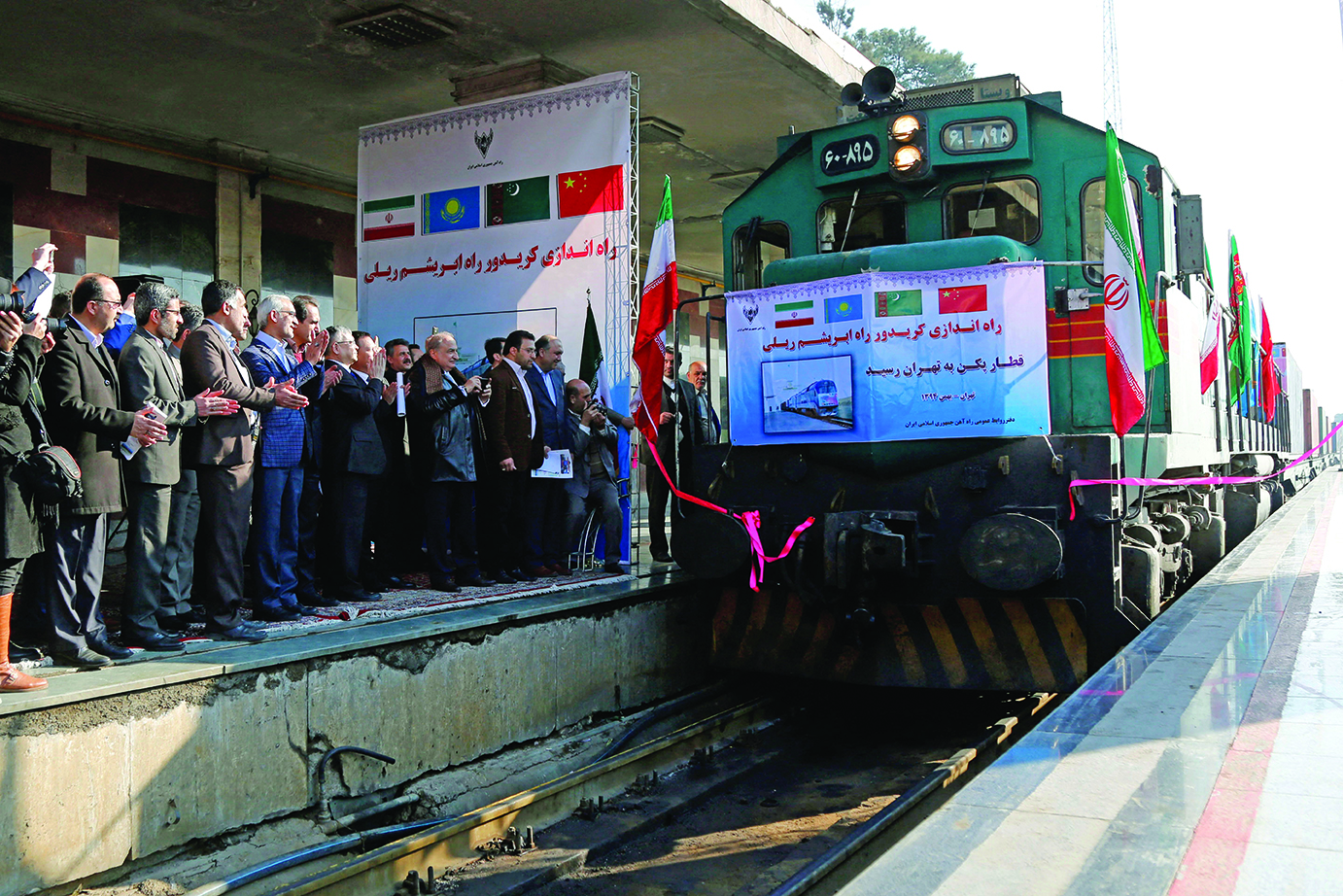
Iran has resorted to using a 10,000-kilometer rail corridor with China to bypass the United States’ naval blockade that is choking its oil exports.
Although land routes can supply the Iranian economy with food and manufactured goods, commodities traded in bulk, such as oil, rely on the efficiencies of sea transport. Any hopes that long-distance rail can provide an economic lifeline to the Iranian regime are implausible.
“Rail can move strategically meaningful volumes, but it cannot, in the near term, substitute for tankers at scale,” Steve H. Hanke, a professor of applied economics at Baltimore’s Johns Hopkins University, told Radio Free Europe/Radio Liberty.
Trains began moving cargo on the Kazakhstan-Turkmenistan-Iran corridor in 2016, mostly as an export corridor for Chinese goods. That rail traffic remains relatively modest.
According to Bloomberg News, cargo trains riding the rails between Xi’an in central China and Tehran averaged about one per week before the start of the war. Once the U.S. blockade of Iran began on April 13, the frequency has increased to about one every three or four days.
Trains can transport cargo faster than ships, but sacrifice carrying capacity.
Sources estimate that nations in the region are losing $1.2 billion per day in oil and gas revenues from the closure of the Strait of Hormuz.
Energy News Beat, a news agency that covers the oil and gas industry, provided compelling estimates: A very large crude oil carrier can haul up to 2.2 million barrels. By comparison, a long train with more than 100 cars could haul only 70,000 barrels.
“Iran would need roughly 25-35 such trains. The entire corridor’s current daily throughput — dominated by general containers and non-bulk freight — is nowhere near that level,” Energy News Beat noted.
The problem is the same with shipping container freight. Trains hauling dozens of shipping containers at a time are no substitute for cargo ships that can carry thousands.
Nevertheless, land routes, using both rail and truck traffic, could still act as a backdoor to resupply Iran with Chinese components for drones, missiles and precursors for rocket fuel. That’s one of the few remaining options to the sea lanes that remain inaccessible to Iran.
International sanctions tied to Iran’s pursuit of nuclear weapons have blocked direct sales of Iranian oil since 2018. Nevertheless, Iran continued to sell oil to China through use of a shadow fleet of tankers that disguised the oil’s origins. The U.S. blockade has stopped most or all of those sanctions evasions.
Because of the ongoing naval blockade, the prospects for Iran’s oil-based economy remain gloomy. The country usually produces about 4 million barrels of oil a day, about half of it exported.
Most of that is bottled up, consuming valuable storage space that, if not relieved by the return of sea-going tankers, will reach capacity soon. A possible long-term collapse in oil revenue would follow.
“The sea blockade is a much more serious threat than even war, and the current stalemate must be broken because the export of our oil and energy and the fate of our refineries is now at risk,” Hamid Hosseini, an expert on Iran’s oil sector at Iran’s Chamber of Commerce, told The New York Times.
During the May 2026 meeting between Chinese President Xi Jinping and U.S. President Donald Trump, both leaders agreed that Iran cannot have a nuclear weapon, called to reopen the Strait of Hormuz and agreed that no country or organization can be allowed to charge tolls for use of international waterways.