

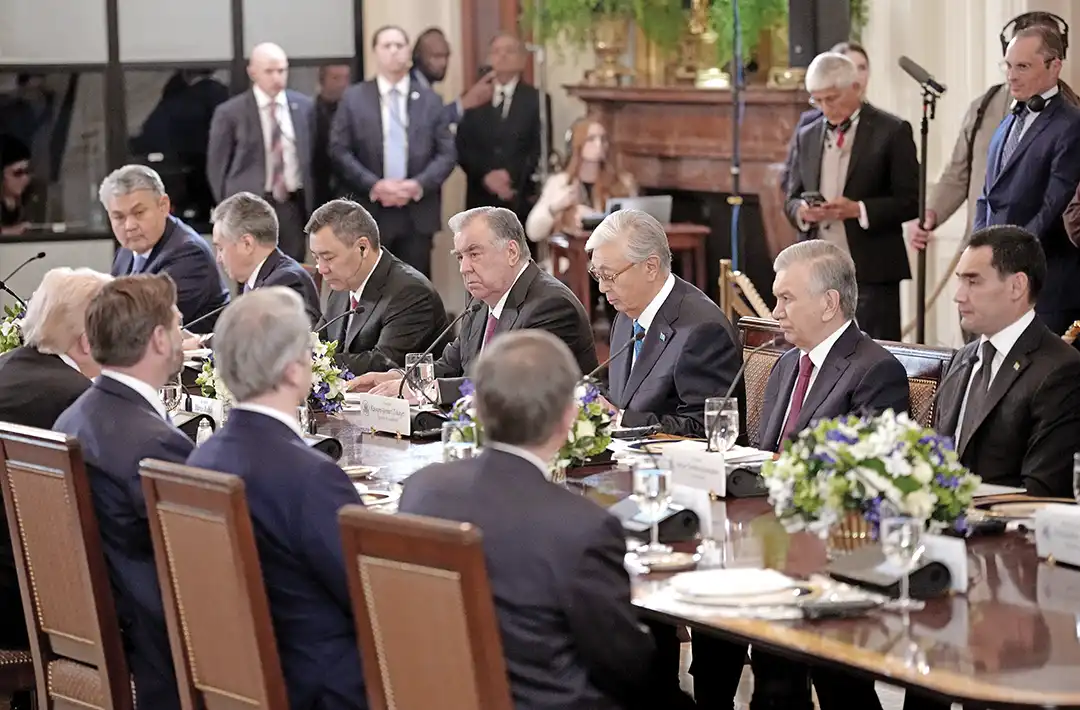
In pursuit of deeper strategic cooperation with the United States, the presidents of Kazakhstan, the Kyrgyz Republic, Tajikistan, Turkmenistan and Uzbekistan attended their first summit with a U.S. president in November 2025.
U.S. President Donald Trump hosted the heads of state at the White House in Washington, D.C., where improved security partnerships, business investment and trade represented critical topics of discussion. The historic engagement was part of the C5+1 process established in 2015.
“Today’s summit shows that the United States of America sees Central Asia as a key partner. Together we can develop a future based on trust,” Uzbek President Shavkat Mirziyoyev said before his fellow heads of state.
Kazakhstan’s President Kassym-Jomart Tokayev called the summit the beginning of a new era of cooperation between Central Asia and the United States and praised President Trump for his global statesmanship. The meeting came several weeks after a U.S.-backed ceasefire in Gaza took effect.
“I highly appreciate your unwavering support to advancing Kazakh-American multifaceted cooperation,” President Tokayev said.
Tajikistan’s President Emomali Rahmon highlighted ways in which U.S. engagement benefited his country. In addition to prospective U.S. investment in Tajik mineral production, President Rahmon cited security cooperation related to the country’s border with Afghanistan.
“We particularly have excellent cooperation in counterterrorism and fighting extremism and drug trafficking,” the Tajik president announced at the gathering of his fellow leaders.
Kyrgyz President Sadyr Japarov praised the U.S. president for his contribution to global peace, security and stability.
“Kyrgyzstan values the United States of America as one of the important partners in foreign policy,”
he said.
President Japarov stressed his own nation’s contribution to regional stability by fulfilling its promise to resolve border disputes with neighboring states, disputes left over from the days when the region was ruled by the Soviet Union.
“Together with my counterparts, we have successfully achieved this goal, most importantly through peaceful means,” the Kyrgyz president said.
Turkmenistan’s President Serdar Berdimuhamedov expressed his commitment to diplomatic engagements with his neighbors and the U.S. in areas such as security, economics and energy production.
Turkmenistan’s government, consistent with its policy of permanent neutrality, has expressed support for the proposed Trans-Caspian Pipeline to transport its natural gas under the Caspian Sea to Azerbaijan, Türkiye and Eastern Europe. However, the project faces significant political, legal and technical challenges, including concerns raised by other Caspian littoral states and the need for regional cooperation.
“We believe that the results of this summit will lead us to further expansion of multifaceted cooperation between Central Asia and the United States,” President Berdimuhamedov told the diplomatic gathering at the White House.
As host of the summit, President Trump praised Central Asia as one of the most important regions
of the world. Citing its wealth and “incredible potential,” he announced billions of dollars in trade and investment deals that promised to reshape the U.S.-Central Asian relationship.
“I’m committed to making America’s partnership with each of these countries stronger than ever before,” President Trump said.
One important area of military-to-military cooperation between the U.S. and Central Asian countries is the annual Regional Cooperation exercise hosted by U.S. Central Command. The exercise focuses on Central Asian security, peacekeeping and stabilization by creating a multinational headquarters staff tasked with handling a simulated border crisis.