

The complex threats confronting the Middle East and South and Central Asia — including state-sponsored terrorist organizations, attacks on strategic waterways, and the use of ballistic missiles and unmanned aerial systems by adversaries — demand a flexible mindset from the United States and its partners.
At a time when U.S. service members and many partners have come under fire from hundreds of unmanned aerial systems, rockets and missiles, U.S. Central Command, in cooperation with our partners, continues to seek advantages on the battlefield through innovation.
Innovation is not optional. It is critical to our success. Over the past two years, the air, ground, sea and special operations components of USCENTCOM have created separate task forces to adopt, test and field technologies and tactics to improve the warfighting capabilities of our troops.
As a longtime U.S. Navy surface warfare officer, I’m deeply acquainted with threats to freedom of maritime navigation in the region, which encompasses three of the world’s eight strategic waterways — the Strait of Hormuz, Suez Canal and Bab el-Mandeb. Any threat to these waterways is a threat to a global economy that gets about a third of its oil and gas from the Middle East.
With terrorist organizations controlling territory on the Red Sea and threatening cargo ships reliant on the Suez Canal, global trade remains vulnerable to disruption. That’s neither in the interest of the U.S. nor its Middle Eastern partners.
We have responded to this threat. Maritime drones — on the surface, underwater and overhead — have extended the range of our sensors. Sailors can see over the horizon as never before. Artificial intelligence systems allow us to more easily sift, sort and compile millions of bits of intelligence gathered by our unmanned systems.
But our adversaries are arming themselves with similar technology, which in many cases is less expensive and easier to obtain than traditional military equipment. That’s why we have fast-tracked technology and training to counter unmanned aerial systems, testing concepts through recurring military exercises.
Military innovation requires collaboration with industry to ensure we adopt cutting-edge equipment as quickly and efficiently as possible. We benefit from a U.S. government program called Accelerate the Procurement and Fielding of Innovative Technologies that provides financial incentives to companies producing innovative products with military potential.
Employing technology effectively to confront adversaries also requires a shift in mindset. Nations of the Arabian Gulf region have discussed developing a shared aerial early-warning system called Integrated Air and Missile Defense.
By linking sensors, sharing intelligence and responding as a team, Gulf nations aspire to create a defensive shield capable of disrupting aerial threats no matter their altitude, speed or course. Such a project will require not just advanced technology but the will to put aside national differences.
Over the past several years, I have had the privilege to command forces based in the Middle East. That time has given me a front-row seat to the challenges facing the region. But it also has convinced me that innovation, introduced in a spirit of partnership, is necessary for maintaining peace and security.
This edition of Unipath will address some of the challenges we face and the innovations we need to embrace to overcome them.
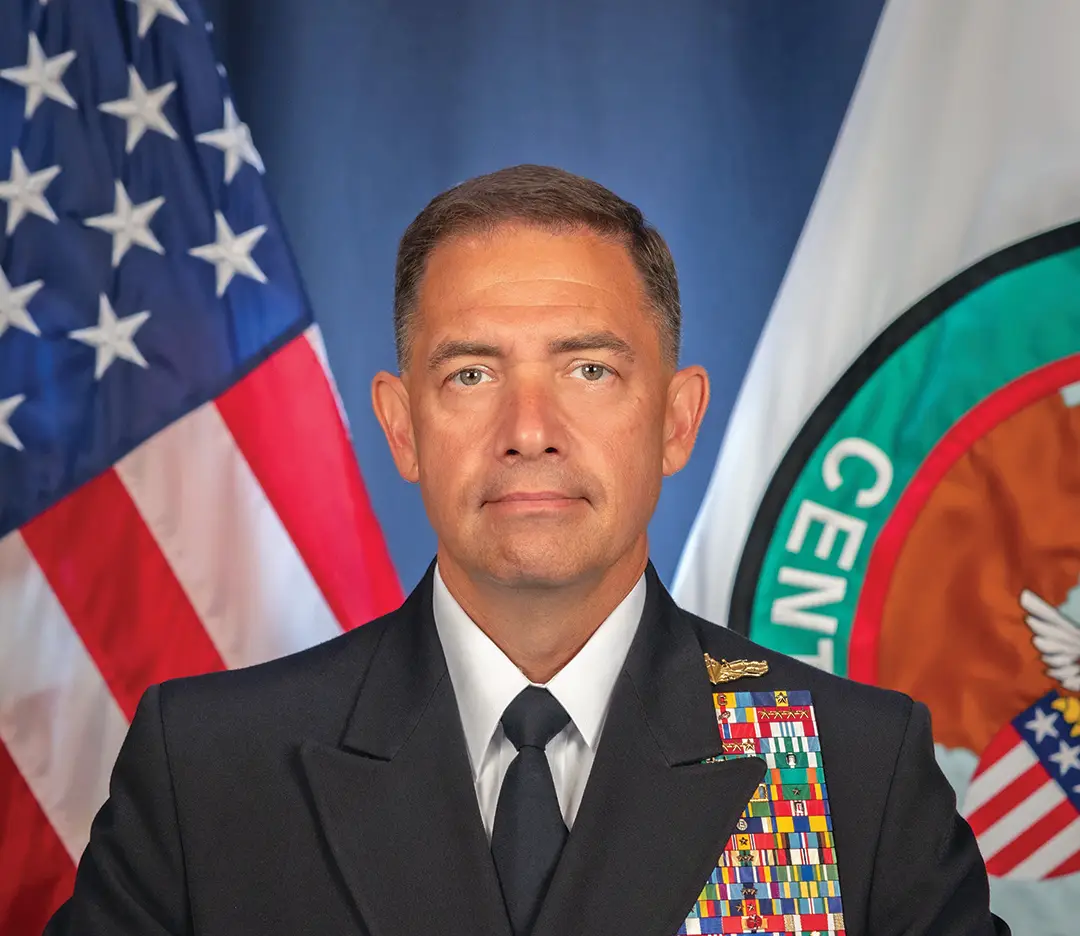
Adm. Brad Cooper
Commander, United States Central Command