
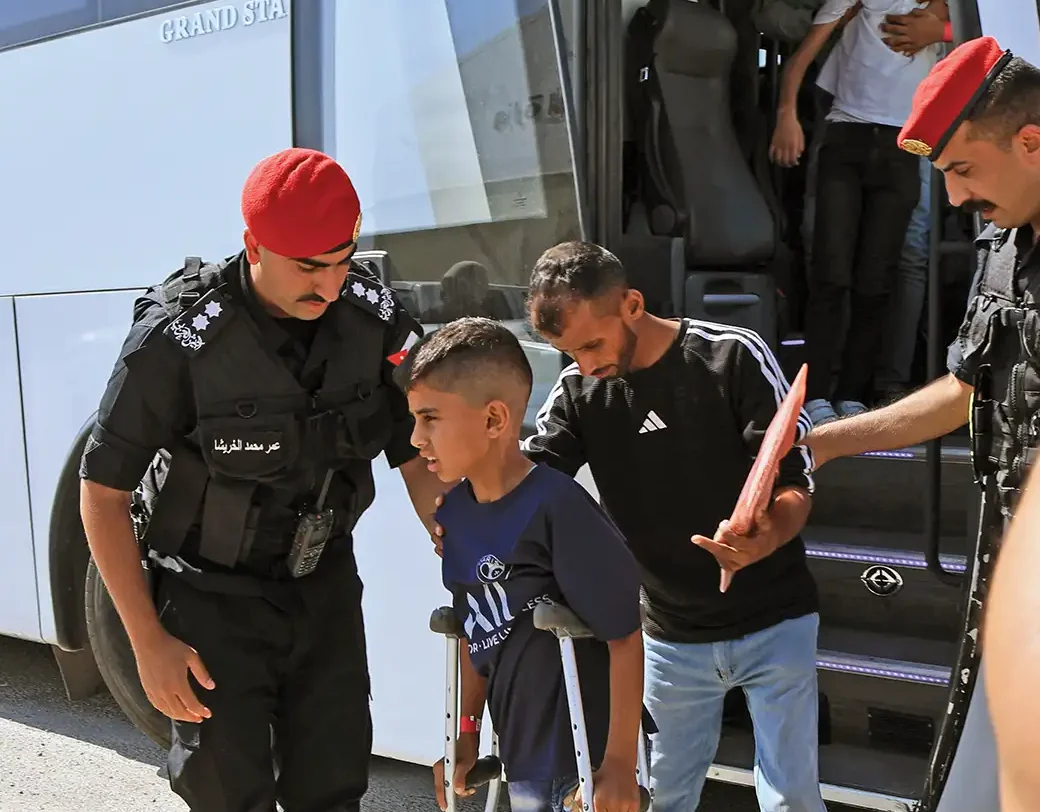
In one of the most complex humanitarian crises of modern times, the Hashemite Kingdom of Jordan, represented by the Jordan Armed Forces-Arab Army, has emerged as one of the most prominent examples of an organized and continuous response to support civilians in Gaza.
Under the direct guidance of His Majesty King Abdullah II ibn Al Hussein, Supreme Commander of the Armed Forces, Jordanian troops have prioritized human dignity based on a well-established humanitarian approach. This centerpiece of Jordanian policy affirms that protecting civilians and alleviating their suffering is a moral responsibility not subject to political or geographical considerations.
The Jordan Armed Forces established a field hospital in Khan Yunis in southern Gaza with a capacity of 41 beds and 41 incubators for newborns. The hospital also encompasses various clinics run by specialized medical staff from the Royal Medical Services. Since the beginning of the war, two Jordanian field hospitals in Gaza have treated about 879,000 cases, reflecting the scale of Jordan’s medical intervention.
The Jordan Armed Forces provided two fully equipped mobile clinics, accompanied by a medical team from the National Center for Amputee Rehabilitation, as part of the “Restoring Hope” initiative. About 770 upper and lower prosthetic limbs were fitted to injured people from Gaza. This marks the shift in support from emergency relief to longer-term rehabilitation and reintegration.
The Jordanian Medical Corridor initiative also ensured the medical evacuation to Jordanian hospitals of 1,807 people from Gaza, comprising 519 patients accompanied by 1,288 family members.
To overcome difficulties of accessing Gaza by land routes, the Jordan Armed Forces is adopting multiple strategies to deliver aid, most notably carrying out 564 airdrops of food, medical and relief supplies across Gaza. Of these, 400 were carried out as joint operations with friendly countries and 164 were carried out by Jordan alone. In coordination with the Jordanian Hashemite Charity Organization and the Ministry of Foreign Affairs and Expatriates, the Armed Forces also conducted an airlift from Marka Military Airport in which 102 flights flew directly to Gaza. Another 53 flights flew to Egypt’s El Arish Airport carrying about 125 metric tons of humanitarian aid, urgent medicines and milk for children.
The Jordan Armed Forces, in cooperation with its partners, sent 201 relief convoys through land crossings. These consisted of 8,664 trucks loaded with 111,361 metric tons of food, medical supplies and basic shelters, which directly contributed to alleviating suffering among Gaza residents.
Jordan’s assistance is not limited to direct relief efforts. Jordanian diplomats have pressed the case for Palestinian relief at international forums. They have called for a cessation of humanitarian violations and promoted the Palestinian people’s right to self-determination and a pathway to statehood. This approach ensures that Jordan’s humanitarian work and its political stance are aligned.
These indicators also confirm that the role of the Jordan Armed Forces in Gaza was not temporary or circumstantial, but rather an extension of well-established humanitarian policy based on royal directives and the values upon which the Jordanian state was founded.
In light of the challenges facing the international response to conflicts, Jordan’s experience has emerged as a model of organized humanitarian relief. It confirms the kingdom’s commitment to humanitarian principles and its ability to play an active role that transcends geographical boundaries and promotes the values of solidarity and international responsibility.