

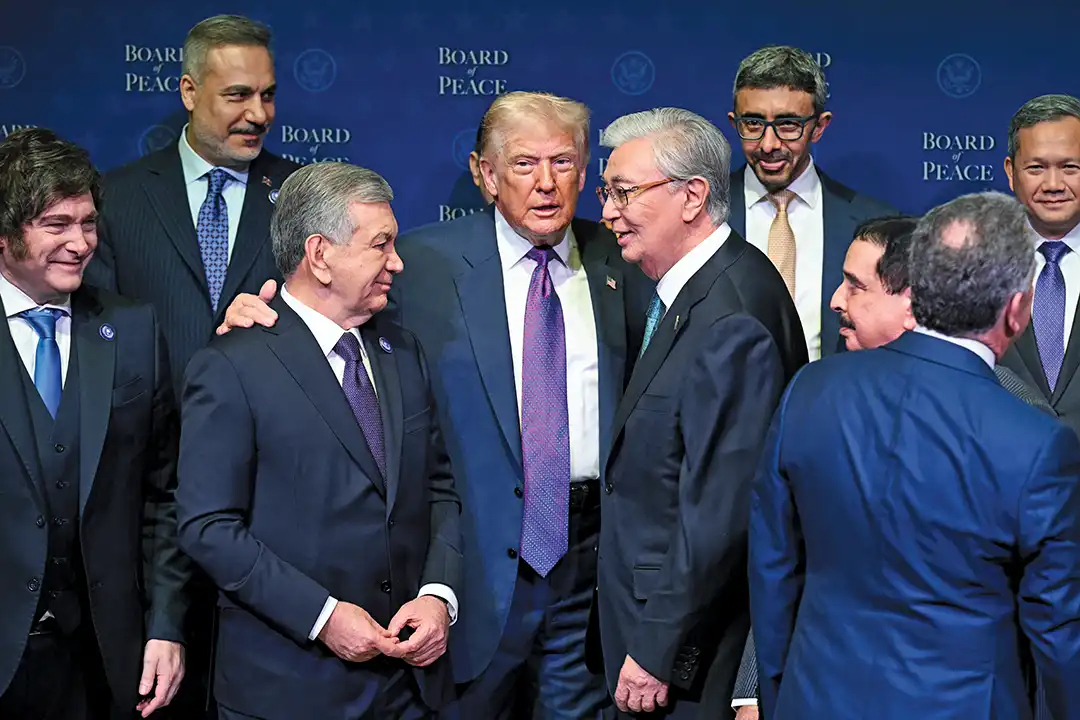
The new Board of Peace initiated and chaired by United States President Donald Trump was created to foster peace and stability and to manage post-conflict reconstruction in Gaza.
Kazakhstan and Uzbekistan were among the 20 nations who sent leaders to Davos, Switzerland, in January 2026 to sign the charter bringing the new organization to life.
For the two Central Asian neighbors, joining the Board of Peace as founding members offers a chance to shape international conflict resolution mechanisms and to amplify their voices and influence globally.
Uzbekistan President Shavkat Mirziyoyev expressed strong support for the Board of Peace and indicated his country would participate in its practical implementation. “Our meeting is a vivid manifestation of international solidarity, peacebuilding and a common aspiration to improve the situa-tion in the Middle East,” he said in an official statement.
Mirziyoyev also noted that Uzbekistan’s founding participation in the project is not simply a routine diplomatic effort but an example of its evolving role on the international stage.
“It reflects a fundamental choice in favor of dialogue, good neighborliness and constructive interaction,” according to Bakhtiyor Mustafaev, deputy director of Uzbekistan’s Institute for Strategic and Regional Studies.
At the ceremony creating the board, Kazakhstan’s President Kassym-Jomart Tokayev praised the pragmatic nature and “innovative concept” of “peace through construction.”
“It is about making durable peace through practical, target-oriented measures, not through endless conferences with wishful resolutions,” he said.
Tokayev indicated that, in addition to reconstruction projects, Kazakhstan is prepared to support humanitarian efforts in Gaza through food security support, medical units for a stabilization force and educational grants for Gaza students at Kazakh universities.
The Board of Peace has been endorsed by the United Nations Security Council as a transitional authority with a mandate to stabilize and rebuild Gaza. However, Trump expressed support for expanding it into a permanent fixture to deal with other conflicts.
Sources: The Times of Central Asia, U.N. Security Council, Dunyo Information Agency, Office of the President of the Republic of Uzbekistan, Office of the President of the Republic of Kazakhstan, The Astana Times