

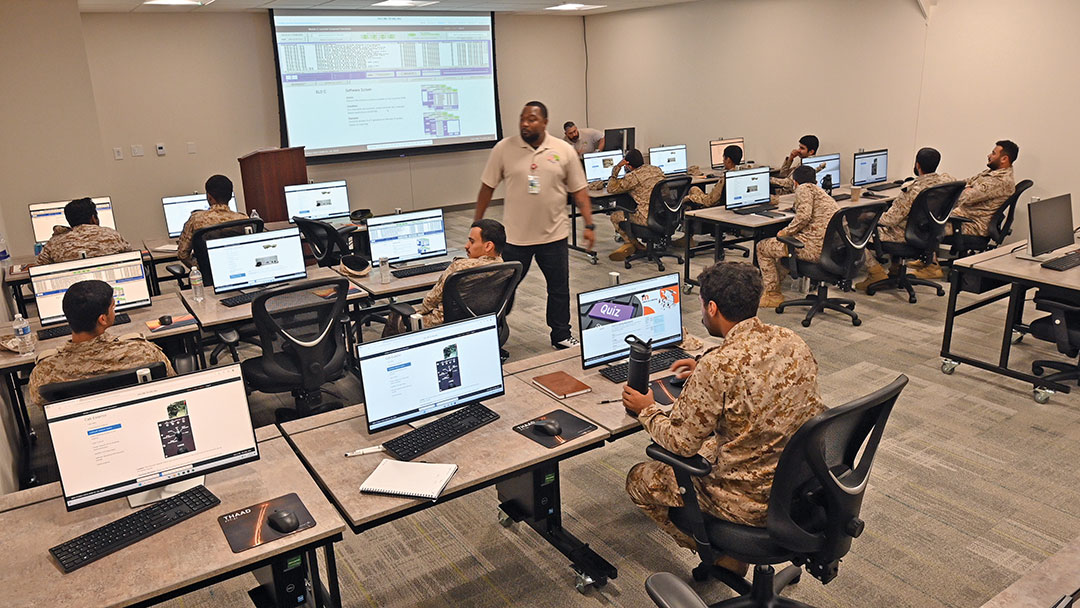
Modernizing its ballistic missile defenses, the Royal Saudi Air Defense Forces (RSADF) has commissioned its first battery of the U.S.-made Terminal High Altitude Area Defense (THAAD) system.
In a commissioning ceremony at the Saudi Air Defense Forces Institute in Jeddah in July 2025, RSADF Commander Lt. Gen. Maziad bin Suleiman al-Amro presented the battery’s flag to the commanding officer of the newly formed unit.
To operate the THAAD system, a team of Saudi officers completed a two-phased training course in the United States. The first phase consisted of 20 weeks of individual training at Fort Bliss, Texas. Each trainee had to pass an English test and meet other requirements. The second phase involved field training in Saudi Arabia itself.
Ninety-seven Saudi officers completed individual training in Fort Bliss in November 2024, but the goal is to train more than 760 Saudi service members to operate seven THAAD batteries.
In November 2018, U.S. and Saudi officials signed a $15 billion contract for the Kingdom of Saudi Arabia to buy 44 THAAD missile launchers, 360 THAAD interceptor missiles and other equipment.
A THAAD battery consists of six M1120 launch trucks with eight interceptor missiles each, two mobile tactical operations centers and ground-based radar with a surveillance range of up to 966 kilometers.
Designed to defeat short-, medium- and intermediate-range ballistic missiles in their terminal flight phase, THAAD has played a significant role in protecting the U.S. and allied forces since it first entered service in 2008.
“It will enhance Saudi Arabia’s air defense capabilities to intercept ballistic missiles through space,” said Dr. Ahmed al-Shihri, head of the Saudi Expertise Forum.
Saudi Arabia ensured that some components for THAAD were assembled locally to enhance Saudi manufacturing and technological capabilities as part of a defense procurements nationalization plan outlined in the Saudi Vision 2030.
Saudi Arabia and the U.S. are committed partners and regularly take part in bilateral and multilateral military training exercises, such as Red Flag, Eagle Resolve and Red Sands, to enhance interoperability and boost air defense capabilities.
Sources: Al Jazeera, Army Recognition, centcomcitadel.com