

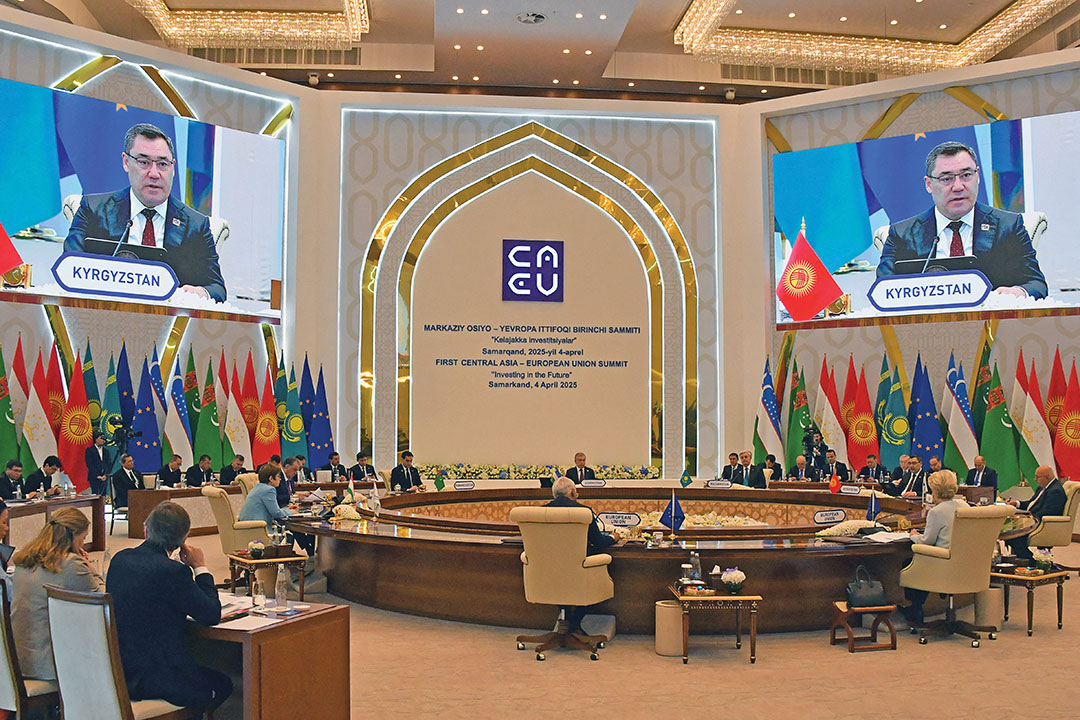
The nations of Central Asia, an important crossroads between east and west, are seeking to expand economic and political partnerships outside of the region.
Leaders of the European Union and the five nations of post-Soviet Central Asia — Kazakhstan, the Kyrgyz Republic, Tajikistan, Turkmenistan and Uzbekistan — met in Samarkand, Uzbekistan, April 3-4, 2025, to advance these ties.
During the summit, leaders discussed topics including multilateral and regional cooperation, security challenges, trade and investment, energy, human rights, and scientific and educational exchanges and cooperation.
This first-ever high-level EU-Central Asia summit is just the beginning of what EU leaders hope will be a growing partnership. The United States has held similar summits of its own with Central Asian states.
“I believe our relationship has not yet reached its full potential,” said António Costa, president of the European Council, who co-headed the EU delegation with European Commission President Ursula von der Leyen. “This summit marks the start of a new dimension in our relations, and it will not be a one-off.”
Befitting the summit’s host city of Samarkand — a historically famous stop on the ancient Silk Road trade route —trade and investment were key topics of discussion.
The EU is already Central Asia’s largest investor and second-largest trading partner. Central Asia seeks access to advanced European industrial technology, while Europe is a customer for the region’s natural resources.
To facilitate increased trade and travel, von der Leyen confirmed that the EU will invest 10 billion euros in the Trans-Caspian International Transport Route, which will vastly cut travel time between Central Asia and Europe while bypassing geopolitically unstable Russia.
It was agreed that future cooperation should be within the legal frameworks of current and future bilateral enhanced partnership and cooperation agreements (EPCA). Kazakhstan and the Kyrgyz Republic already had EPCAs in place with the EU and, as a result of meaningful negotiations following the summit, Tajikistan agreed to its own EPCA with the EU in July 2025.
Uzbekistan President Shavkat Mirziyoyev, who hosted the summit, focused on how much Central Asia has done in just a few years to open borders and facilitate improved relations within the region, making it possible to hold such a summit.
“Seven or eight years ago, borders between states were closed. There was no trade, no business. … Relations were frozen,” President Mirziyoyev said. “Nobody would have imagined that we could unite to represent the region at negotiations with European leaders.”
Sources: European Council, Radio Ozodlik, Delegation of the European Union to Tajikistan