

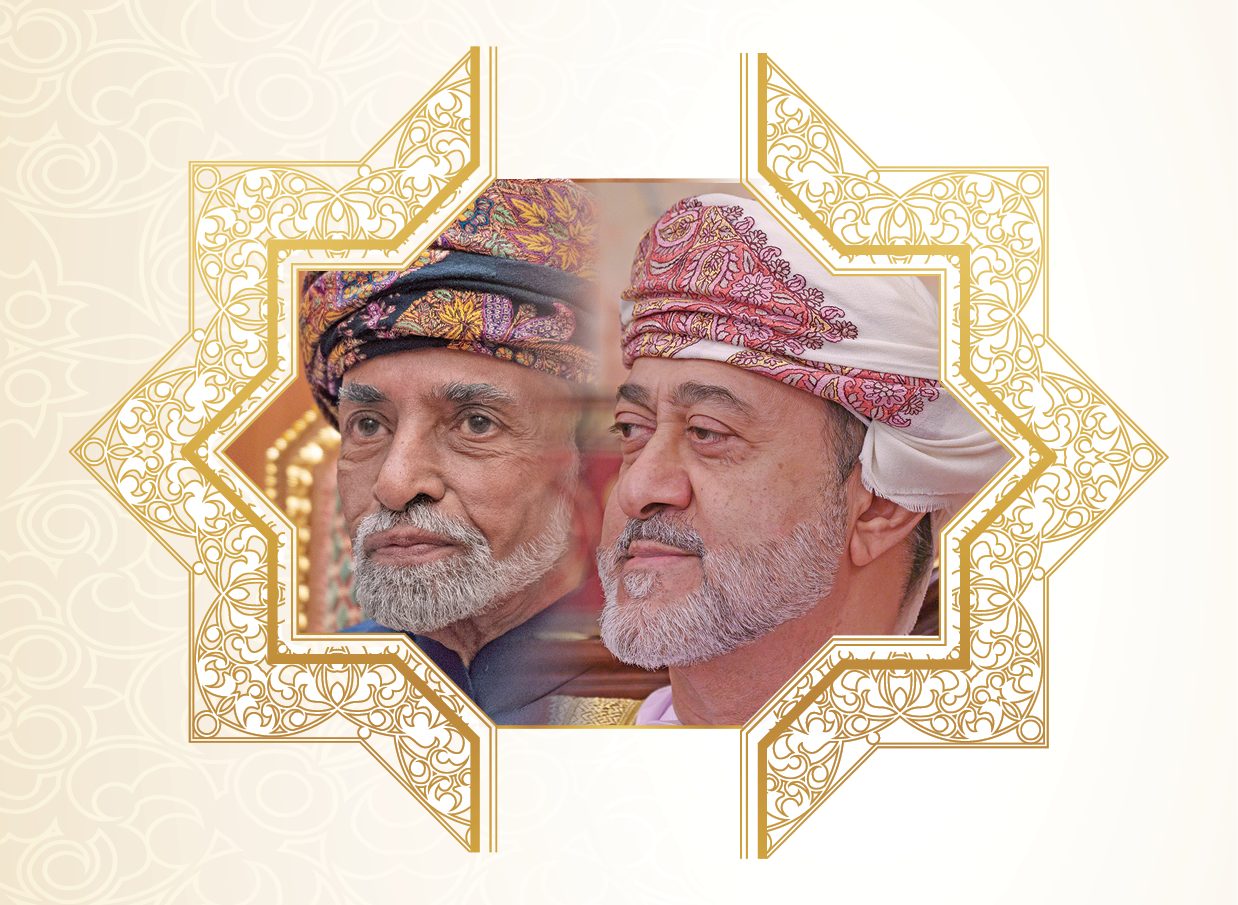
The late Sultan Qaboos was a bold leader who transformed Oman for the better
UNIPATH STAFF
The death of His Majesty Sultan Qaboos bin Said in January 2020 has left behind a legacy of service, security and stability that has benefited not just Oman but the entire region.
And the inauguration of Haitham bin Tariq Al Said as the new sultan of Oman promises a continuation of that progress. He is Sultan Qaboos’ cousin, a seasoned diplomat and a former minister of heritage and culture.
Arab and Western countries offered condolences for the death of Sultan Qaboos, praising his prudence in dealing with regional and international issues and his role in modernizing his country during his nearly 50-year reign.
Mourning his death, the Arab League General Secretariat lowered its flag to half-staff for three days, and Secretary-General Ahmed Abul Gheit eulogized Sultan Qaboos in a statement.
“The Arab nation lost a ruler of a rare type who, during his reign, adopted a neutral trajectory for his country in responding to many crises and conflicts that beset the region,” the secretary-general announced.
His Majesty King Salman bin Abdulaziz Al Saud of Saudi Arabia and His Royal Highness Crown Prince Mohammed bin Salman paid tribute to the sultan, describing him as “the leader of the Sultanate of Oman and the founder of its modern renaissance.”
Ascending to power in Oman was not an easy ride. The road was dangerous and risky. Sultan Qaboos assumed the throne while the country was suffering from a dangerous internal conflict. Located in a volatile region, Oman’s stability and prosperity required sober leadership.
Between 1963 and 1975 the sultanate witnessed one of the longest armed conflicts in the region called the Dhofar Rebellion. The sultan’s forces fought, in partnership with Great Britain, a war against an armed Marxist movement backed by what was then the People’s Democratic Republic of Yemen.
The rebellion took place in the southern province of Dhofar. At what was known as the Hamrir conference, the radical Marxists who led the rebellion decided to expand it to include all the Arabian Gulf states. Consequently, the group changed its name from the “Popular Front for the Liberation of Dhofar” to the “Arab Front for the Liberation of the Occupied Arab Gulf.”
In 1970, Qaboos succeeded his father, Sultan Said, and embarked on a widespread reform movement in which the construction of schools, hospitals and highways was prioritized. Thanks to the wisdom and prudence of Sultan Qaboos — as well as the regional and international support he attracted — the situation improved in favor of Sultan Qaboos’ forces, and the Dhofar Rebellion ended in 1975.
From the dissolution of the rebellion until his death, Sultan Qaboos professed neutrality and maintained a nonaligned foreign policy based on reciprocity and mutual respect for neighboring countries and the rest of the world.
At times, the sultan mediated between international rivals and sought to find common ground to promote reconciliation between warring parties. During the reign of its devoted leader, Oman became renowned for good governance and effective foreign policy. That laid the foundation for stability and prosperity that raised Oman’s stature in the Middle East and the world. Its police force was recently ranked among the world’s best.
Oman’s economic achievements under Sultan Qaboos are noteworthy. In 2010, the United Nations honored Oman as the country that had developed more than any other during the preceding 40 years. Even China lagged behind Oman.
His Majesty Sultan Haitham bin Tariq, known for his global outlook during his years serving as an Omani diplomat, graduated from Oxford University’s Foreign Service Programme in 1979. As such, he’s viewed as a leader who will continue to extend Oman’s hospitable hand to the world.