
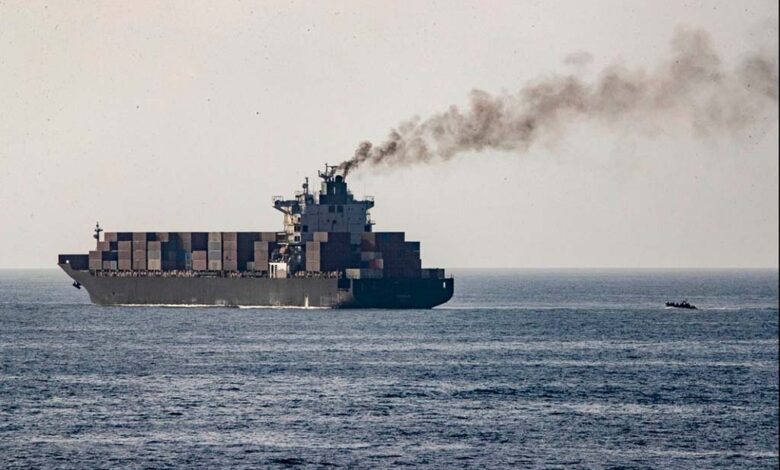
United States forces intercepted an Iranian-flagged cargo vessel in the Gulf of Oman sailing from China toward an Iranian port, as well as a dark fleet tanker tied to Iranian smuggling in the Indo-Pacific in April 2026 as part of the U.S. Department of War’s mission “to disrupt illicit networks and interdict sanctioned vessels providing material support to Iran — anywhere they operate.”
The U.S. Navy guided-missile destroyer USS Spruance intercepted the Iranian-flagged M/V Touska en route from China as it violated the U.S. blockade of Iranian ports. U.S. officials suspected it was carrying dual-use items that could be used by the Iranian military, according to reports. The container ship is part of the Islamic Republic of Iran Shipping Lines group that has been under U.S. sanctions since 2020 and acts as “the preferred shipping line for Iranian proliferators and procurement agents,” including transporting items intended for Iran’s ballistic missile program, according to the U.S. Treasury Department.
The U.S. shipping blockade on Iran includes cargo deemed contraband — including weapons, ammunition, and crude and refined oil products, as well as iron, steel and aluminum. Any vessels suspected of trying to reach Iranian territory will be “subject to belligerent right to visit and search,” the U.S. Navy said.
Satellite information detected the Touska at China’s Taicang port north of Shanghai in late March 2026 and four days later at China’s southern Gaolan port, the Reuters news agency reported, citing analysis from the U.S.-based company SynMax. The vessel loaded containers in Gaolan and then in Malaysia in mid-April.
According to United Nations and U.S. officials, Chinese firms have shipped chemicals, fuel and components to Iran for military use. China also is suspected of shipping shoulder-fired missiles to Iran.
U.S. forces disabled the Touska’s propulsion after the crew failed to comply with repeated warnings over a six-hour period, according to U.S. Central Command. U.S. Marines boarded the ship to inspect its 5,000 shipping containers. Through April 20, the U.S. Navy had turned back 27 ships trying to enter or exit Iranian ports since the blockade outside the Strait of Hormuz began earlier that month. The Touska was the first ship to attempt to circumvent the blockade, which includes the Gulf of Oman and the Arabian Sea east of the strait, encompassing the entire Iranian coast.
Two days after the Touska intercept, the U.S. announced it had conducted a right-of-visit maritime interdiction of the stateless M/T Tifani, in accordance with the United Nations Convention on the Law of the Sea Article 110 and customary international law, in the U.S. Indo-Pacific Command area of responsibility. The Tifani has been under U.S. sanctions since 2025 for its involvement in smuggling Iranian crude oil and providing support to Iran’s illicit networks. The vessel, linked to transporting millions of barrels of oil from Iran, is suspected of conducting ship-to-ship transfers to deliver cargo to prohibited destinations.
The interdictions underscore the U.S. mission to disrupt illicit maritime activity linked to sanctioned states and actors. Allies and Partners have conducted similar operations. The Indian Coast Guard, for instance, disrupted an international oil smuggling network in February 2026, intercepting three vessels about 100 nautical miles west of Mumbai. The Indian Defence Ministry said the operation “dismantled an intricate network involved in the illicit transfer of large volumes of oil and oil-based cargo originating from conflict-ridden regions.”
The U.S. also recently seized multiple tankers carrying illicit oil from Venezuela.
“International waters are not a refuge for sanctioned vessels,” the U.S. Department of War said after the Tifani’s interdiction. The U.S. “will continue to deny illicit actors and their vessels freedom of maneuver in the maritime domain.”