

A platoon of infantrymen fans out across a steep, rocky hillside, weaving among mountain pines to ensure no enemy forces interfere with their mission of evacuating civilians injured by landmines.
Having quickly stabilized the casualties’ physical injuries, platoon medics address panic among the civilians, including a man hysterical at the sight of a friend’s severed leg, while carrying stretchers across the uneven terrain.
These Soldiers were participating in an exercise scenario as part of field training at Regional Cooperation 2026 (RC26). The platoon encountered the civilians in a minefield during a stabilization patrol in the disputed zone of a small fictional country. Before reaching the wounded civilians, the patrol dealt with enemy unmanned aerial systems (UAS) and a chemical weapons threat.
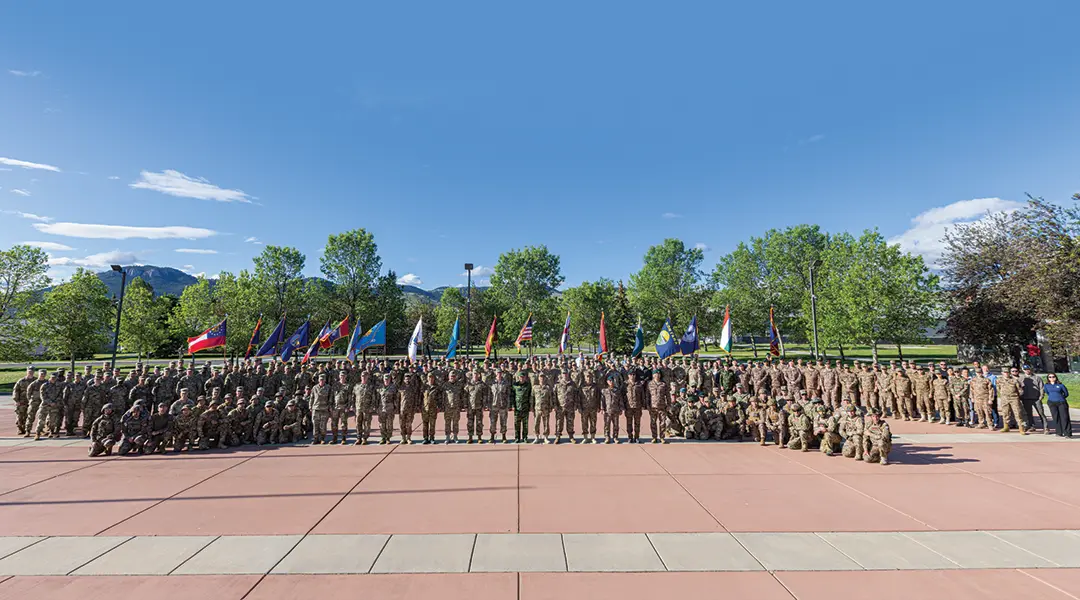
Regional Cooperation is U.S. Central Command’s premier multinational exercise designed to strengthen cooperation with partner nations in Central and South Asia. The exercise integrates a command post exercise (CPX), a field training exercise (FTX) and a cyber exercise (CSX) within a common exercise scenario. RC26, which ran June 1-12, was hosted by the Montana National Guard at Fort William Henry Harrison, and marked the exercise’s 30th anniversary.
Regional Cooperation aims to improve the ability of partner nations to conduct stability operations as a multinational coalition in missions that include United Nations peacekeeping.
Regional Cooperation has endured because its training continually adapts to real-world threats, said U.S. Army Lt. Col. Randall Phillips, CENTCOM’s lead exercise planner for RC26. When adversaries adopted UAS and cyberattacks, for example, so did Regional Cooperation’s scenarios.
“This exercise remains relevant across three decades of changing commanders, shifting priorities and evolving security challenges,” Lt. Col. Phillips said.
U.S. Soldiers and Airmen from multiple combatant commands and eight state National Guards were joined by more than 320 partner troops from the Kyrgyz Republic, Pakistan, Tajikistan, Uzbekistan, Armenia, Georgia and Mongolia. This was the first time that Armenia and Georgia participated in Regional Cooperation, expanding the exercise’s reach to partners from the Caucasus.
The exercise has evolved since it began in 1996, particularly in recent years as it grew from mostly a command post exercise into a dynamic, integrated training environment.
RC26 also introduced new technology: The first ever test deployment of the Long-Range Joint Precision Airdrop System (LR-JPADS) in a training environment and, in the CSX, the first use of an artificial intelligence (AI) training platform in the exercise.
The LR-JPADS is a GPS-guided, self-propelled, survivable and reusable cargo delivery system designed to air drop cargo pallets precisely into contested terrain. The unmanned system can carry a 320-kilogram payload as far as 400 kilometers, or farther with a lighter load, allowing it to resupply isolated forces, such as special operations and reconnaissance teams, while reducing exposure to aircraft and air crews.
The CPX
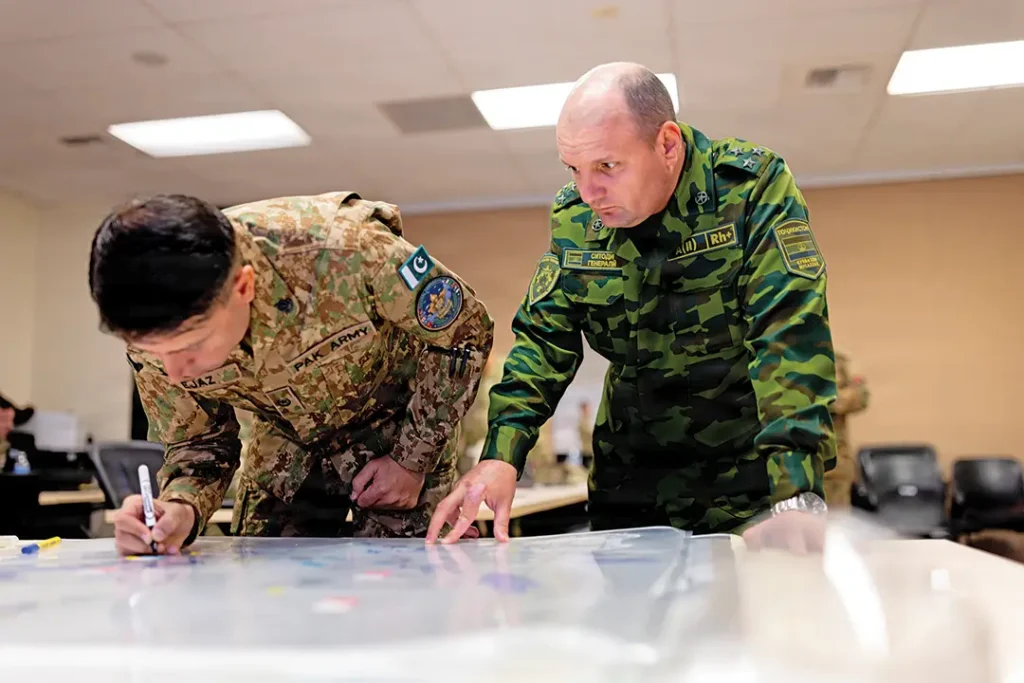
Participants in the CPX operated as military headquarters staff to plan, synchronize and execute simulated military combat and stabilization operations based on the realistic scenario devised by exercise planners. Officers and noncommissioned officers were assigned to multinational sections based on military specialties, including intelligence, operations, logistics, plans, information operations, civil affairs and special forces.
The staff overcame language and cultural obstacles to accomplish the objectives of the CPX.
“This exercise provides an opportunity to understand each other’s ways of working and cultures, and provides a platform to learn from each other’s experiences and best practices,” said Col. Shahid Hussein, the senior delegate from Pakistan.
Col. Hussein is a 26-year veteran of his country’s Armed Services who had previously served on a U.N. peacekeeping mission in Liberia.
“It’s interesting to see that militaries worldwide have more commonalities than differences in practices, discipline and operational cultures,” the colonel said. “We are all students of military history and have that in common.”
Col. Akybek Ahmedsharipov, the CPX commander and senior delegate from the Kyrgyz Republic, agreed.
“I’m very grateful for the opportunity for our delegation to participate in this exercise,” he said. “We enjoyed receiving this valuable experience and knowledge.”
Command Sgt. Maj. Battulga Baatar from Mongolia, the senior NCO for RC26 and a veteran of peacekeeping missions in Africa and combat in Afghanistan, appreciated that NCOs could participate and contribute to the process.
“My favorite portion of this exercise is the NCOs’ involvement in the joint environment — watching our NCOs step up, share their expertise and actively contribute to the planning process has been truly outstanding,” he said. “This will help them grow and improve their leadership skills.”
Lt. Col. George Gognadze, the senior delegate from Georgia, is a senior planner at the Georgia-NATO Joint Training Evaluation Center in his home country, which has hosted joint exercises Agile Spirit and Noble Partner with U.S. forces.
He has been an exercise planner for 15 years and, based on extensive experience, Lt. Col. Gognadze and the rest of the Georgian delegation worked as exercise control and observers, rather than participants. Georgia has expressed interest in hosting a future iteration of Regional Cooperation.
A major feature of Regional Cooperation, according to Lt. Col. Gognadze, is that it introduces the Central Asian partners to the NATO-U.S. planning methodology, a bottom-up process with which they remain unfamiliar because they use the top-down processes inherited from the days of the Soviet Union.
“This exercise will surely be beneficial for Georgia, too,” he added. “This multinational environment is important for Georgia and for other nations.
The FTX
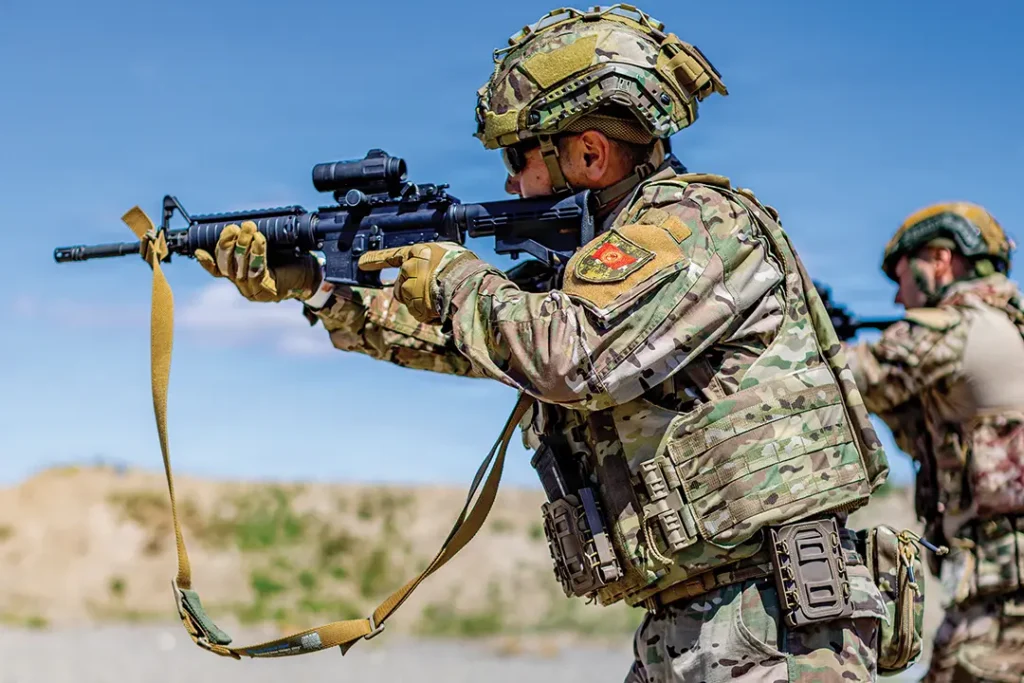
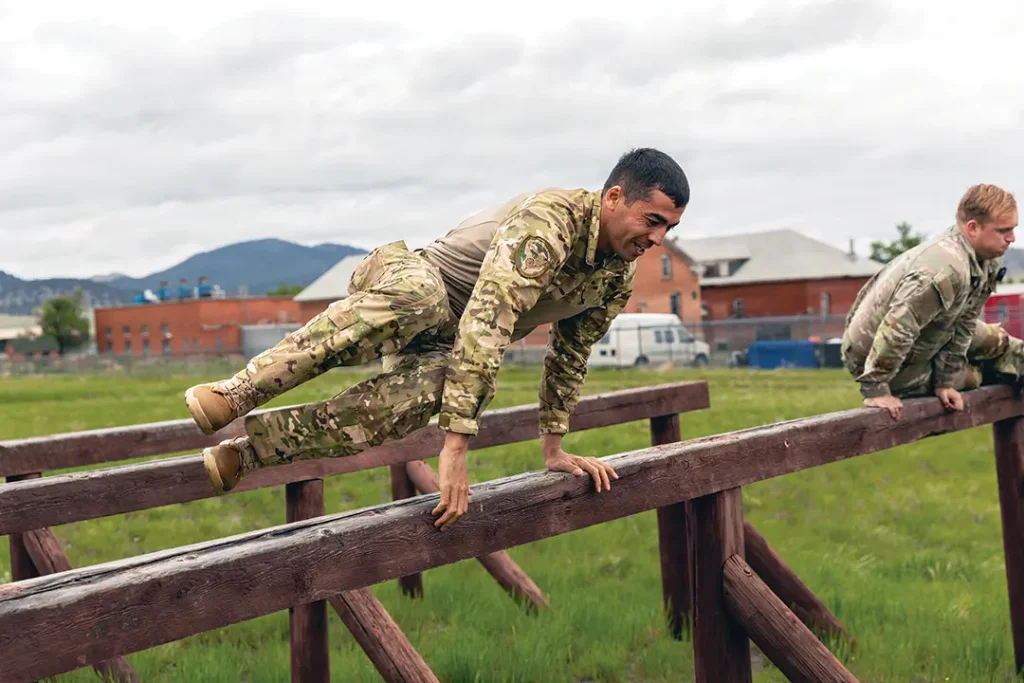
Over the years, the FTX has expanded and integrated more closely with the CPX. In Montana, participants underwent nearly two weeks of training before the culminating event. The first week consisted of obstacle course, land navigation, hand-to-hand combat and weapons training. It also provided a good opportunity for multinational troops to get to know each other.
Sgt. Nicholas Hill of the Oklahoma Army National Guard was impressed with how well partner-nation troops worked together thanks to their high levels of fitness, professionalism and motivation.
“They all have a competitive spirit and pride in representing their countries to the best of their ability,” he said. “They’re tough — really tough.”
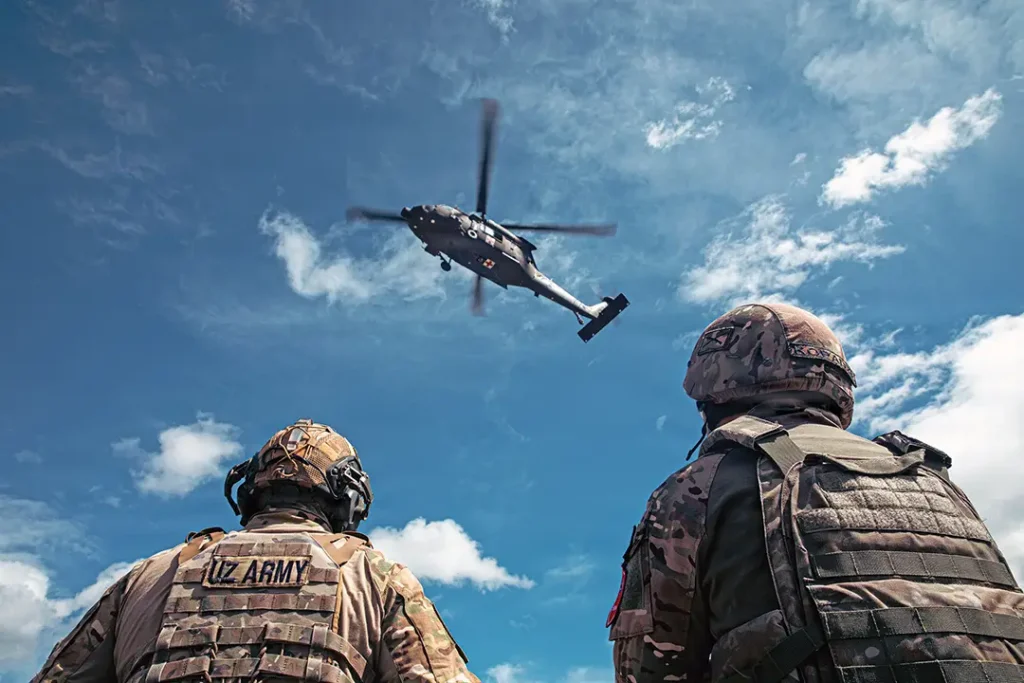
The second week of the FTX focused on operating and countering UAS, using helicopters and evacuating simulated battlefield casualties to prepare for a culminating event in which the training coalesced. Spirit of America, a privately financed, national security nonprofit organization that works closely with the U.S. State and War departments, donated the bright red medical kits used in the training, which partner Soldiers were able to keep.
As a result of the intensive training and familiarization, the joint FTX force maneuvered and communicated efficiently in the concluding event. The final day of the FTX also included an airborne parachute insertion and LR-JPADS test launch.
The CSX
The cyber component of the exercise was in only its third year, but increased in intensity and scope with the introduction of a new AI training platform.
Although relatively new to Regional Cooperation, the CSX is viewed as critically important because of security threats emanating from cyberspace.
“Cybersecurity is a fundamental component of our defensive posture,” said U.S. Army Chief Warrant Officer 3 Amber Horn, in charge of the RC26 CSX. “In our increasingly connected, multidomain battlespace, strong cyber hygiene is not just an IT issue. It’s mission imperative.”
The CSX started with four days of classroom instruction to refresh basic cybersecurity skills, including use of the new AI training platform that vastly increases the speed of identifying cyber threats.
“It’s important to not fall behind technological trends,” Armenian Capt. Artur Poghosyan, an RC participant, said of AI.
During the second week, the cyber warriors put their training to work to defend computer systems, preventing network tampering, identifying signs of compromise and repelling attacks. In the scenario, the teams countered cyberattacks by four state-sponsored groups that tried to cripple critical infrastructure.
Looking ahead
As multinational troops completed RC26 and prepared to depart, the value of Regional Cooperation was apparent.
“This exercise has been a great step toward continuing our partnership, our cooperation, and building trust between our nations,” said Col. Bobokalon Shohzoda of Tajikistan. “We will use the knowledge we received here and the skills we developed here to further advance our regional cooperation.”
Brig. Gen. Trent Gibson, adjutant general of the Montana National Guard, emphasized the core value of Regional Cooperation.
“This exercise underscores what matters most, and that is relationships,” he said. “Training objectives were met, but more importantly, vital friendships were forged.”