
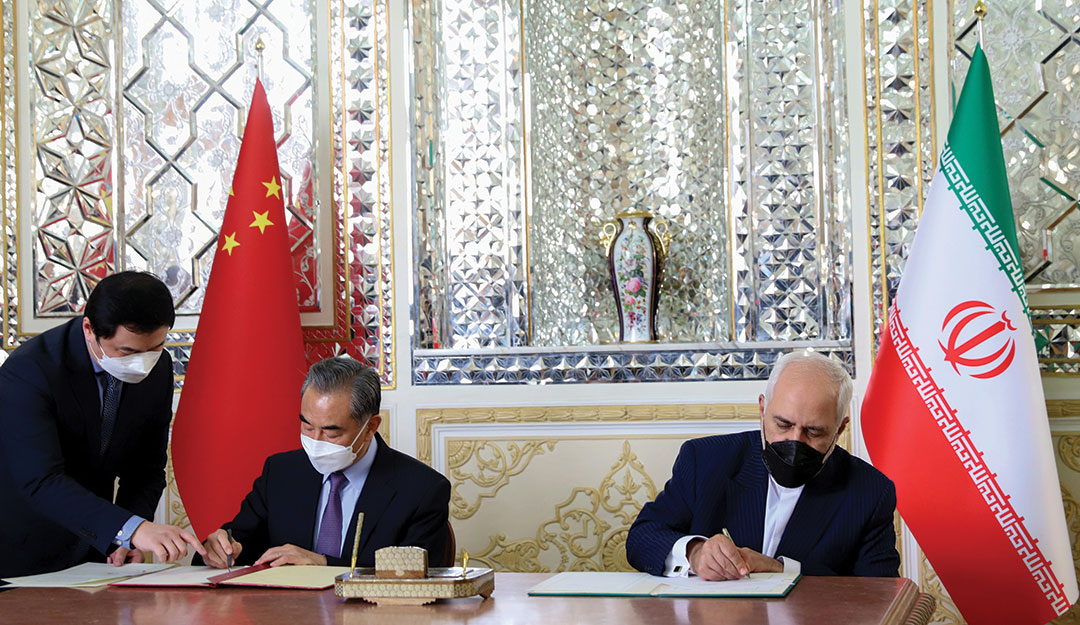
The web of cooperation between China and Iran widened with the development of ballistic missile and space launch vehicle (SLV) technology in the year leading up to joint United States and Israeli combat operations in Iran, which began February 28, 2026.
Under economic and political cover, the partnership between Beijing and Tehran increasingly encompasses dual-use technology transfers, provision of precision components and precursor chemicals for solid rocket motors, and support of logistical networks that materially strengthened Iran’s strategic strike capabilities. These activities, rooted in the 2021 Comprehensive Cooperation Agreement (CCA) between the two regimes, loom more significantly for global security given the recent Middle East conflict, ongoing intensified sanctions enforcement and growing strategic competition, especially in the Indo-Pacific.
Understanding the drivers, mechanisms and consequences of China-Iran military cooperation will be key to countering collaborations and safeguarding security in the Indo-Pacific and the Middle East.
Evolving China-Iran Relations, Military Ties
China-Iran relations date back centuries to ancient trade routes, but their modern alignment accelerated after Iran’s 1979 Islamic Revolution brought Ruhollah Khomeini to power. As Tehran became increasingly isolated from Western suppliers, Beijing emerged as an alternative source of arms, technology and diplomatic cover. International pressure and nonproliferation concerns periodically constrained the relationship, but it consistently rebounded in response to shifting regional dynamics and mutual strategic interests.
During the 1980-88 Iran-Iraq War, China reportedly supplied Iran with Silkworm anti-ship cruise missiles and other systems. The Ayatollah Ali Khamenei, who was killed in the February 2026 Israeli-U.S. strikes, came to power in 1989 after Khomeini’s death. Through the 1990s, U.S. intelligence assessments indicated that Chinese entities assisted Iran’s missile and nuclear programs, particularly in providing machine tools, specialty metals and technical expertise. Though Beijing pledged in the late 1990s under U.S. pressure to curtail certain forms of missile-related cooperation, concerns about indirect and dual-use transfers persisted.
The China-Iran relationship entered a new phase with the launch of the 2016 Comprehensive Strategic Partnership and subsequent signing of the 25-year CCA. Under the purported economic and infrastructure pact aligned with Beijing’s One Belt, One Road (OBOR) infrastructure scheme, China pledged $400 billion to Iran in energy, transportation, telecommunications and security. While the full text was not publicly released, Iranian officials described provisions for defense-industrial collaboration and joint research. Security analysts contend the deal enabled transfers and logistics coordination of military technologies and components, marking a turning point in the volume of military trade between the regimes.
 Solid Rocket Motor Precursors, Dual-Use Transfers
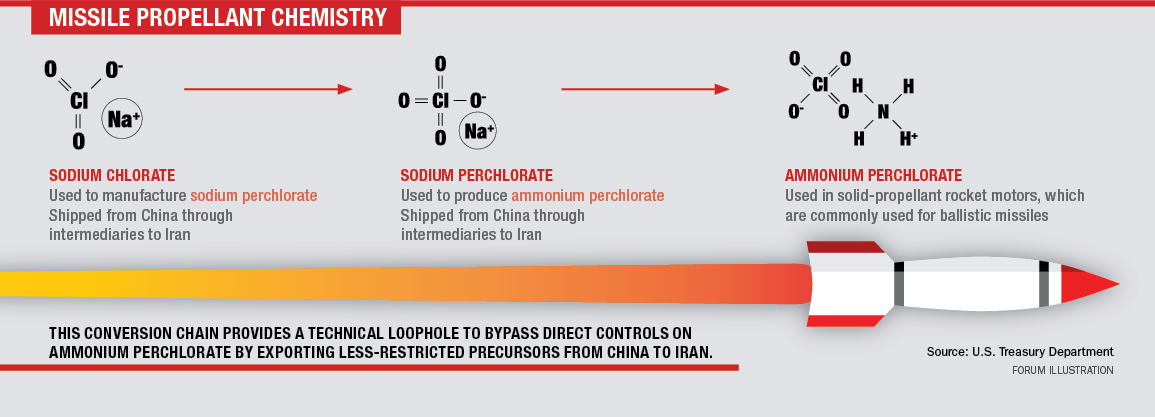
After U.S. airstrikes on Iran’s key nuclear facilities in June 2025, evidence emerged of China’s intensified support for Iran’s missile and space ambitions, particularly dual-use technology transfers and supply of precursor materials for solid rocket motors.
Solid rocket motors, which are critical for ballistic missiles and SLVs, offer operational advantages over liquid-fuel systems: faster launch times, greater survivability and improved storage stability. Iran’s advancements in this domain underpin systems such as the Emad and Sejjil families of solid-fuel, medium-range ballistic missiles and newer SLVs. These motors rely on specialized chemicals such as ammonium perchlorate and hydroxyl-terminated polybutadiene.
According to the United Nations, Chinese firms have exported significant quantities of these chemicals, more than 3,000 metric tons annually in 2024 and 2025, to Iranian state-owned enterprises, including the Islamic Revolutionary Guard Corps (IRGC) and contractors, often via complex logistics chains designed to evade detection and sanctions. U.N. Security Resolution 2231, enacted in 2015, bans the sale of such dual-use chemicals to Iran through procurement channels. Over the past year, the U.S. has sanctioned multiple procurement networks allegedly tied to Chinese intermediaries for supplying significant quantities of ammonium perchlorate precursors, aluminum powder, composite materials and precision machine tools, items essential to manufacturing high-performance solid propellant. Although the chemicals have civilian uses, the issue is end-use verification and the pattern of repeated diversion to sanctioned Iranian entities. In the past year, the U.S. has also increased sanctions targeting China-linked financing of Iranian nuclear and ballistic missile activities through oil and car manufacturing exchanges.
Beyond chemicals, Chinese companies have supplied advanced composites, electronic components, guidance systems and machine tools adaptable for missile production. The transfer of expertise related to rocket motor fabrication, propulsion optimization and payload integration further enhanced Iran’s capabilities. Chinese entities also have played a key role in bridging critical technology gaps in Iran’s solid-fuel missile programs, analysts say, lowering the technological barrier for Iran’s long-range strike ambitions.
Several sanctioned networks allegedly supplied Chinese-origin gyroscopes, accelerometers and electronic components. Such items can significantly enhance guidance accuracy. Meanwhile, Iran has also increased direct arms purchases from China to strengthen its weapons supply chain.
In February 2026, days before Epic Fury was launched, Iran was nearing a deal to purchase advanced anti-ship cruise missiles from China, according to the Reuters news agency. The Chinese-made CM-302 supersonic missiles have a range of about 290 kilometers and can evade shipborne defenses. The CM-302, which reportedly can sink an aircraft carrier or destroyer, would extend Iran’s anti-access/area-denial reach across the Strait of Hormuz, a vital oil shipping choke point. The two regimes also discussed Iran buying China’s DF-17 hypersonic glide missile, the Defence Security Asia website reported.
Bandar Abbas Explosion, Escalating Risks
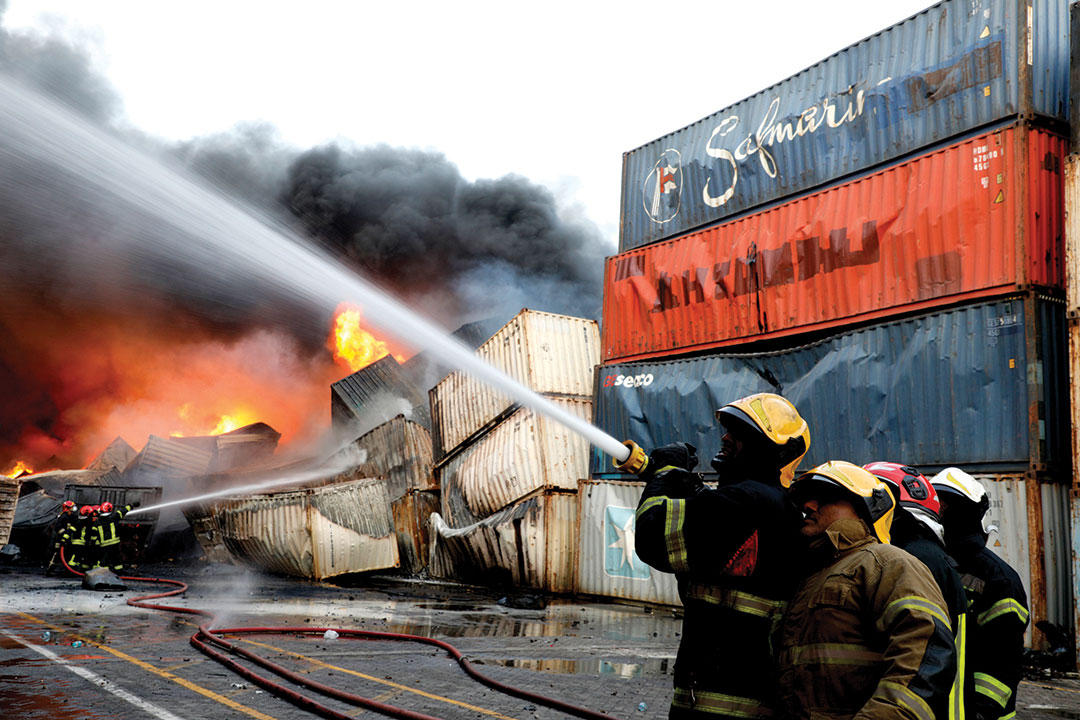
In April 2025, a deadly explosion rocked facilities near the port of Bandar Abbas, Iran’s principal maritime gateway. Iranian authorities attributed the blast to an industrial accident amid speculation over sabotage or mishandled propellant materials. Analysts said the destroyed containers held precursor chemicals and electronic components destined for missile production.
Satellite imagery and shipping records indicated the presence of a Chinese-flagged vessel docked at the port shortly before the explosion, raising questions about the nature and origin of the cargo as well as the dangers and complexity of intertwined logistics networks and missile-related transfers.
Logistical support remains central to China’s assistance to Iran. Chinese shipping companies and freight forwarders have reportedly used ports in Southeast Asia and the Middle East to transship sensitive materials, obscuring their origin and destination through inaccurate labeling, shell companies and false cargo manifests.
Space, Military Crossover
Although Iran maintains that its space program is peaceful, the U.S. and its allies and partners have long asserted that Tehran’s SLV development provides technological overlap with intercontinental ballistic missile research. Analysts point to shared propulsion systems, guidance technologies and staging techniques.
Iranian SLVs in recent years have demonstrated improvements in thrust vector control and multistage integration — capabilities that mirror solid-fuel missile advancements.
After the strikes on Iranian nuclear and ballistic missile centers in June 2025 during the U.S.’s Operation Midnight Hammer, Iran quickly rebuilt much of its ballistic missile program, according to satellite images and intelligence assessments, The New York Times reported in February 2026. “The emphasis that’s been put on rebuilding the missile program stands in contrast to the nuclear program,” Sam Lair, a research associate at the U.S.-based James Martin Center for Nonproliferation Studies, told the newspaper. He said the Shahroud missile test facility, Iran’s largest and newest solid-propellant missile production plant, was likely rebuilt within months of the 2025 U.S. operations.
Commercial Footprints, Interlocking Firms
The facilitation of Iran’s missile and SLV programs relies on collaboration among networks of Chinese and Iranian firms. Chinese state-owned enterprises and private technology companies have established joint ventures and front companies in Iran, enabling the procurement and transfer of sensitive materials. Iranian entities, including the Aerospace Industries Organization and the Shahid Hemmat Industrial Group, serve as primary recipients, often working through intermediaries to mask end use and evade sanctions.
In 2025 security analysts identified more than a dozen Chinese firms linked to the export of dual-use items to Iranian missile producers. These firms often operate through murky legal areas, exploiting loopholes in export control regimes and leveraging China’s OBOR infrastructure to facilitate shipments.
The relationship between Chinese and Iranian firms has also complicated enforcement efforts. Chinese energy companies maintain substantial stakes in Iranian oil and gas projects, often using yuan-denominated transactions to circumvent sanctions. Iranian trading companies, in turn, operate procurement offices in Chinese commercial hubs.
U.S. sanctions designations frequently identify shell companies registered in Hong Kong or China’s mainland industrial zones that act as intermediaries. In some cases, Iranian nationals have reportedly established front companies to purchase controlled goods. The Wall Street Journal newspaper revealed a covert payment structure that moves billions of dollars from Beijing to Tehran for crude oil purchases outside the traditional financial system. Similarly, Chinese automakers and metals firms run a barter system with Iran to circumvent the U.S.-led banking system, according to the Bloomberg news organization.
Iranian firms linked to the IRGC — particularly its Aerospace Force — have also sought technical partnerships under civilian auspices. The IRGC is central to Iran’s ballistic missile enterprise, and many sanctioned procurement entities are affiliated with it, the U.N. reported.
Skirting Sanctions, Creating Diversions
China and Iran both benefit from their collaboration. For Iran, Chinese engagement provides economic lifelines and technological access, including more than $34 billion in non-oil trade annually with Beijing becoming the main pillar of Iran’s sanctions evasion strategy, analysts assert.
For China, the calculus appears more strategic than ideological. Iran occupies a pivotal geo-economic position astride energy corridors and maritime routes linking Asia to Europe. Stability in Iranian energy exports supports China’s long-term resource security.
Cultivating Tehran also aligns with Beijing’s broader ambitions while providing plausible deniability of its responsibility for promoting instability. China’s support for Iran’s missile and SLV programs serves to undermine the U.S. and its allies and partners’ missile defenses and influence in the Middle East, securing Beijing’s energy interests and expanding its geopolitical footprint through OBOR. Proxy conflicts in the region, including tensions in Iraq, Syria and Yemen, have increased the demand for advanced missile systems and logistics support. Iran’s provision of missile technology to allied groups has been facilitated in part by Chinese-supplied materials and expertise. The expansion of OBOR infrastructure, including logistics hubs, ports and railways, such as the Qom-Yiwu freight train project launched in 2024, has provided channels for the movement of dual-use goods, complicating efforts by the U.S. and its allies and partners to interdict illicit transfers.
The implications extend to the Indo-Pacific, where China’s growing military-technological links with Iran contribute to broader concerns about proliferation, destabilization and strategic competition.
Iran’s missile arsenal had already changed the security landscape of the Middle East before the strikes in February 2026. Precision-guided systems had enhanced Tehran’s ability to threaten U.S. bases, Gulf energy infrastructure and the Levant. Through Iran’s proxy networks, missile and drone technology has proliferated to nonstate actors.
Strategic competition increasingly manifests through indirect enablement. Understanding and disrupting those links is central to safeguarding regional and global security, defense analysts said.
Broader Security Implications
Prior to the combat operations against Iran, the U.S. and its allies and partners had responded to China-Iran missile cooperation with a mix of sanctions, export controls, intelligence sharing and diplomatic pressure. Expanded targeting of Chinese firms suspected of facilitating illicit transfers, coupled with enhanced maritime interdiction operations, yielded successes but such efforts are hampered by the adaptability of facilitation networks.
Multilateral initiatives, such as the Proliferation Security Initiative, which now includes more than 20 nations, and the Financial Action Task Force, have sought to close loopholes and improve detection of dual-use shipments. However, the integration of OBOR infrastructure and the use of sophisticated logistics concealment tactics pose ongoing challenges. Countering China’s support for Iran’s missile program requires sustained multilateral engagement, technological innovation and increased transparency in global supply chains, analysts say.
The U.S. has also increased diplomatic outreach to regional partners, encouraging enhanced port security, customs cooperation and information exchange. Efforts to incentivize compliance among Chinese firms through secondary sanctions have produced mixed results, as Beijing continues to prioritize its strategic partnership with Tehran.
Through dual-use technology transfers, precursor chemical supplies and commercial intermediation, Chinese-linked networks reportedly enhanced Iran’s capacity to field more advanced solid-fuel missile systems. These developments have direct implications for Middle East stability and indirect consequences for the Indo-Pacific balance that demand sustained vigilance.
If China’s dual-use transfers and military technology collaborations persist with Iran or other failed states, the U.S. and its Allies and Partners will require flexible, multilateral approaches, leveraging innovation and intelligence to disrupt illicit networks, mitigate proliferation risks, and confront the broader security implications.