

When Uzbekistan’s President Shavkat Mirziyoyev visited Washington, D.C., in February 2026, Brig. Gen. James Hankins of the Mississippi National Guard was one of the first people to greet him.
In the same month, a delegation of business, political and military figures traveled from the United States to Bishkek, capital of the Kyrgyz Republic. Prominent among them were representatives of the Montana National Guard.
Both of these exchanges highlight the special relationships formed through the U.S. National Guard Bureau’s State Partnership Program (SPP), which pairs troops from various National Guard units with counterparts from partner countries.
The SPP has enhanced global stability and security for more than three decades. With 107 partnerships across 116 nations, it has grown into one of the U.S. Department of War’s most successful security cooperation tools and an important instrument for advancing U.S. and partner strategic interests.
“The State Partnership Program embodies a cost-effective and collaborative approach to peace through strength. It improves security capabilities of our partners and the readiness of our units,” said U.S. Army Maj. Gen. William J. Edwards, the National Guard Bureau’s director of strategic plans and policy.
“It is the only security cooperation program that delivers sustained, enduring relationships with our partners that our competitors simply cannot match.”
Within the U.S. Central Command area of responsibility, these partnerships have proven invaluable. The five Central Asian nations — Kazakhstan, the Kyrgyz Republic, Tajikistan, Turkmenistan and Uzbekistan — have each developed enduring SPP relationships that entail frequent exchanges among troops.
At the meeting in Bishkek, U.S. Chargé d’Affaires Liz Zentos marked the 30th anniversary of the partnership between the Montana National Guard and the Kyrgyz Ministry of Defense, Ministry of Emergency Situations and Border Service.
The Montana Guard participated in a joint military exercise in the Kyrgyz Republic called Ak-Shumkar in 2025. Zentos noted that more military exchanges are forthcoming.
“We hope to improve and optimize plans for military contacts in 2026 and 2027. Today’s meeting is important for strengthening mutual understanding and finding common ground,” she said.
Since joining the SPP in 2012, Uzbekistan has pursued a close relationship with its partner, the Mississippi National Guard. It has held hundreds of exchanges and joint training events focused mostly on border security and crisis management. Uzbek Soldiers compete annually in the Mississippi Guard’s Best Warrior Competition, where they regularly win top honors.
Kazakhstan’s partnership with the Arizona Guard dates from the program’s inception in 1993. Kazakh Soldiers and Arizona Guardsmen have trained together on peacekeeping, emergency management and professional military education.
Tajikistan, wary of extremism, narcotics trafficking and instability emanating from neighboring Afghanistan, has focused on border security and counternarcotics cooperation in its partnership with the Virginia National Guard. Turkmenistan renewed its participation in the SPP in 2021 and also partners with the Montana Guard.
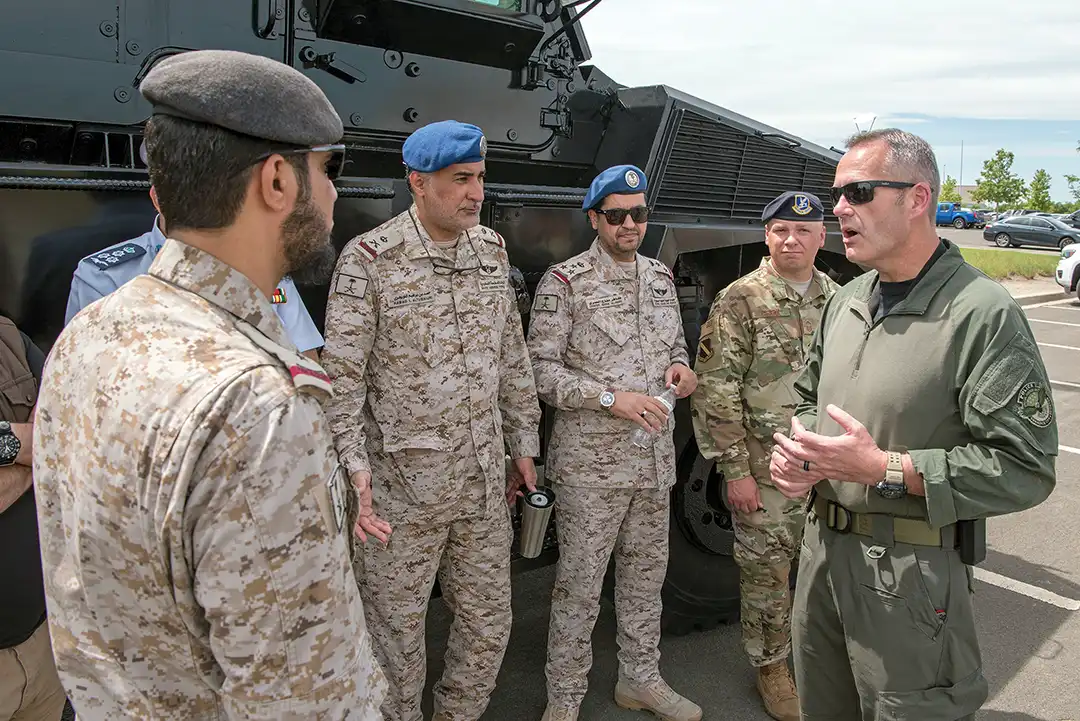
Beyond Central Asia, countries such as Jordan, Oman and Saudi Arabia enjoy productive SPP partnerships, each tailored to national needs, whether in cyber defense, critical infrastructure protection or crisis response. Jordan, one of the oldest and strongest U.S. allies in the region, partners with the Colorado National Guard on disaster response and civil protection training.