
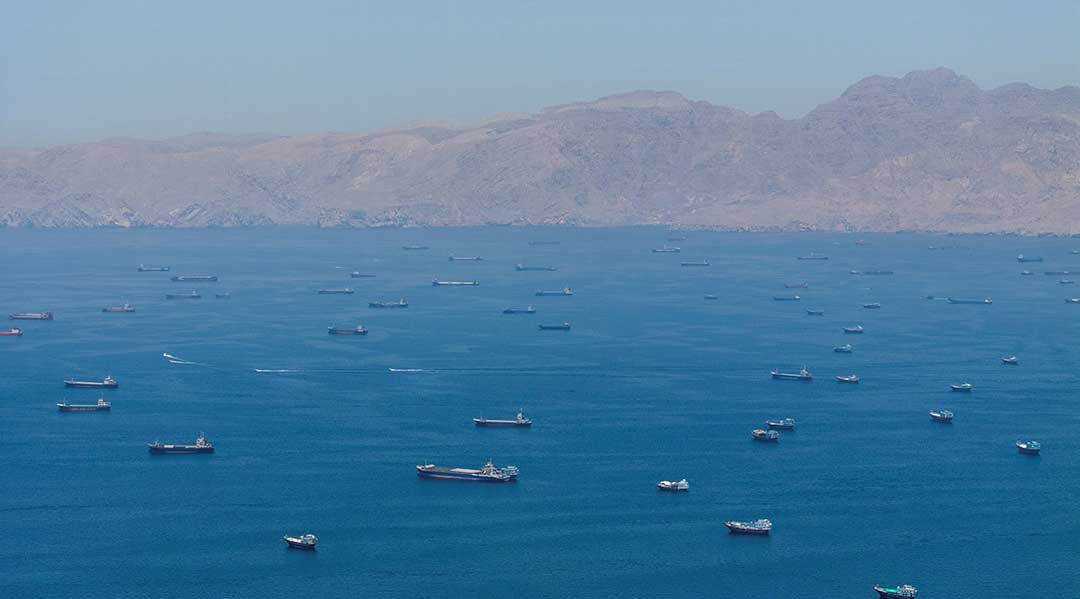

Growing disorder is afflicting the maritime domain from the Pacific Ocean to the Indian Ocean and into the Arabian Gulf region. The crisis in the Strait of Hormuz has shifted the focus of strategic experts from a form of sea blindness, which gave more importance to land security over maritime security, to a deep interest and concern for maritime affairs.
One should view maritime security not just as a military matter but also in terms of economic disruption and human security. Indeed, the Gulf, particularly the Strait of Hormuz, represents one of the world’s most strategically sensitive maritime corridors. It is a transit route for more than a quarter of the global seaborne oil trade and for a significant portion of the world’s liquefied natural gas, fertilizer and essential commodities such as helium.
Since events escalated at the end of February 2026, the number of ships transiting the Strait of Hormuz has dropped by 90%. It is easy to take freedom of navigation at sea for granted, yet the prosperity of nations, the flow of global trade and the growth of the world economy all depend upon it. Maritime routes carry the great majority of international commerce, at a scale that no network of roads, railways or air transport could ever replace. This system connects producers to markets, delivers food and energy between continents and supports the daily lives of billions of people.
However, this transport system is not guaranteed. Disruption of critical sea lanes can quickly affect supply chains, prices, energy, security and economic stability far beyond any region. Protecting maritime routes is therefore not only a matter of national interest but a shared international responsibility.
Qatar firmly believes that maritime security cannot be achieved through military measures alone. It requires a comprehensive strategic approach based on three key pillars:
- The first is dialogue and de-escalation. Regional security is not sustainable without diplomatic engagement and channels of communication among all concerned actors. In this, Qatar, in full coordination with the regional partners, reaffirms its support for the Pakistani mediation efforts, which constitute the most credible and active channel of dialogue.
- The second pillar is respect for international law. The principles of the United Nations Charter and the United Nations Convention on the Law of the Sea (UNCLOS) must remain the foundation of maritime governance. Freedom of navigation and the protection of civilian shipping are essential principles we must preserve jointly. Therefore, Qatar firmly rejects the use of international waterways as a tool of political pressure. If we allow such a precedent, then what we have seen in the Strait of Hormuz can happen in the Indo-Pacific or elsewhere. Article 44 of the UNCLOS clearly says that states bordering straits shall not hamper transit passage.
- The third pillar is international and regional cooperation. No single state can secure maritime routes alone. The complexity of modern threats requires deeper coordination between regional partners and international allies. The situation in the Strait of Hormuz cannot be allowed to reoccur, and Qatar together with our partners will spare no effort to reach a sustainable political solution to keep this waterway safe and fully open.
The security of the Strait of Hormuz and the wider Arabian Gulf is intertwined with global security. What happens in our waters affects global markets and supply chains and international stability itself. The Gulf region is currently the point of impact, but the shock waves extend far beyond it, affecting countries remote from the actual military theater. Safeguarding freedom of navigation is not just a regional priority. It is also an international strategic imperative.
This article is based on a speech delivered on May 30, 2026 at the 23rd International Institute for Strategic Studies Shangri-La Dialogue, a defense and security summit held in Singapore.