
Governments have used various strategies to combat terrorism over time. While there is no international criminal code or international police task force to fight terrorism, countries have seen military confrontation as a viable option. This is legally backed by countries’ inherent right to defend themselves after an armed attack, as stipulated in Article 51 of the United Nations Charter.
Military confrontations against terrorism have become more prevalent than they were in the past. Researchers have noted that there have been relatively few instances where governments used military force in the past, relying instead on police and the courts to fight terrorism.
Nevertheless, various countries around the world have used numerous counterterrorism military strategies over the span of decades:
Protection: Militaries are used to protect civilians and assist national bodies in restoring national law and order.
Preemption: Military forces act to prevent a predicted attack.
Deterrence: Military strength is used to discourage potential terrorist attacks.
Retaliation: Militaries respond in retribution following an attack.
Elimination: Military forces kill key leaders of terrorist organizations to dismantle terrorist networks and disrupt their operations.
Protracted warfare: Military forces engage in longer wars to fight terrorism.
Protection
This involves providing protection and security to citizens, restoring law and order and reinstituting national infrastructure and systems. In a more practical sense, military force can be used to help civilian authorities combat terrorist activities. One effective instance of military assistance and protection is the role of military and paramilitary forces in dealing with hostage rescue missions. These missions could be safely categorized as morally defensible as they are backed by a sufficient legal and constitutional framework.
Starting mostly in the 1970s, some states began conducting or contributing to terrorist violence against the United States. In U.S. public opinion, force has usually been considered as one of the most effective ways to counter terrorism as well as to send a message that the U.S. cannot be intimidated or manipulated through terrorist acts.
In 1980, after Iranian students seized the U.S. Embassy in Tehran and took Americans hostage, the U.S. attempted to use military force to rescue the hostages and de-escalate the situation. The mission was unsuccessful, and as a result of this event, the U.S. Special Operations Command was established, and it currently oversees the special operations capabilities, coordination and training of the numerous American military branches and counterterrorism forces.
After the hostages in Tehran were released, the U.S. shifted the policy of using force against terrorists from defensive to offensive. This approach was demonstrated with the U.S. Air Force targeting key military facilities after receiving intelligence that terrorists based in Libya had bombed a West Berlin discotheque in 1986, killing two American soldiers.
Some counterterrorism responses may lead governments to deploy large numbers of uniformed troops on the streets, but a prominent military presence could incite fear and make governments more unpopular.
Armed forces can also be utilized to protect potential targets of terrorist activity. This includes crucial infrastructure, installations and individuals. One such instance can be found in the fortification of embassies and protection of diplomats.
Preemption
Preemption means striking in advance to prevent an attack from happening. It differs from prevention as the latter could be regarded as a measure to ensure protection in the long term while preemption usually consists of short-term operations. This strategy emerged after 9/11 and stressed U.S. preemption to combat terrorist threats.
The U.S. has frequently used the threat of preemption to avert danger. One such example can be found between 1989 and 1990, when the United States warned it would deploy military force to close the Rabta chemical plant in Libya, which was suspected of producing nerve gas (classified as a weapon of mass destruction). The warning worked and the facility was subsequently shut down.
While preemption might have shortcomings, some scholars argue that the successes of preemptive measures are more recognizable when it comes to killing key leaders of terrorist organizations. Another issue with preemptive measures is their justifiability and moral dimension. While it may be easier to carry out preemptive counterterrorism operations based on intelligence linking particular groups to potential attacks, such measures risk violating international laws and conventions.
Deterrence
This involves maintaining a strong military posture to discourage and drive off terrorist groups. Operation Neptune Spear, carried out by the United States in 2011, led to the death of Osama bin Laden, the top leader of the al-Qaida network and the planner behind the September 11, 2001, terrorist attacks. The U.S. deployed Black Hawk helicopters and highly trained Navy SEALs to carry out this operation in a compound in Abbottabad, Pakistan. Through this operation, the U.S. intended to send a clear message about the consequences of conducting and supporting terrorist activities on American soil. The operation weakened al-Qaida’s leadership and morale and demonstrated the U.S.’s determination to pursue terrorists.
A country having a strong military and a record of retaliation against attacks can also act as a strong deterrent to potential terrorists. In 1996, terrorists stormed the Japanese ambassador’s residence in Lima, Peru, and held foreign diplomats and dignitaries hostage. Among those held hostage were U.S. citizens.
Thanks to a rumor that American Delta Force commandos had landed in Lima and were preparing to raid the residence, the terrorists released the U.S. hostages. The rest were rescued by the Peruvian Special Forces. The rumor turned out to be false but many assucogd the terrorists released the hostages for fear of U.S. military intervention.
Some scholars argue that deterrence has its drawbacks. First, it may create a substitution effect in which terrorists change their course of action or shift their attacks to locations that seem more vulnerable. For instance, they could resort to kidnapping instead of suicide bombing. Another argument is that deterrence isn’t always successful in eliminating terrorism in the long term. It has been noted that a number of countries’ efforts to deter terrorist groups have not been entirely successful, as other terrorist groups did not hesitate to conduct attacks.
Retaliation
As a result of the al-Qaida-orchestrated bombings of the U.S. embassies in Kenya and Tanzania on August 7, 1998, the American military swiftly retaliated against the terrorists through Operation Infinite Reach.
The operation was planned within weeks after the embassy bombings. The U.S. government selected possible targets that would weaken al-Qaida and bin Laden and send a message across the globe that the U.S. and its institutions would not be undermined through terrorism.
The U.S. government identified two targets, including the Khost terrorist training camp 161 kilometers south of Kabul in Afghanistan. U.S. military and intelligence services believed the Khost camp was deeply connected to bin Laden’s terror network.
In addition, the compound housed key al-Qaida leaders and provided an opportunity for the U.S. government to eliminate those targets as well. On August 20, 1998, the U.S. Navy launched a number of cruise missiles, destroying the camp in Khost.
Although Operation Infinite Reach may have weakened bin Laden’s terrorist network in the short term, it did not deter al-Qaida from conducting further attacks on U.S. territory later.
Elimination
Another military strategy used by countries to weaken and eliminate terrorist groups is the killing of key terrorist leaders and personnel.
There have been cases where killing leaders has borne some success in combating terrorism, such as Operation Neptune Spear against bin Laden. His death weakened al-Qaida and may have disrupted future attacks.
The efficacy of killing terrorist leaders to combat terrorism has always been a topic of debate among researchers. Many argue in favor of it, pointing to Operation Neptune Spear. They maintain that eliminating key leadership in terrorist organizations limits the operational capabilities of the groups, making it harder and more expensive for terrorist groups to plan lethal attacks. On the other hand, decapitation can also radicalize a particular group and create an impetus for revenge.
Protracted warfare
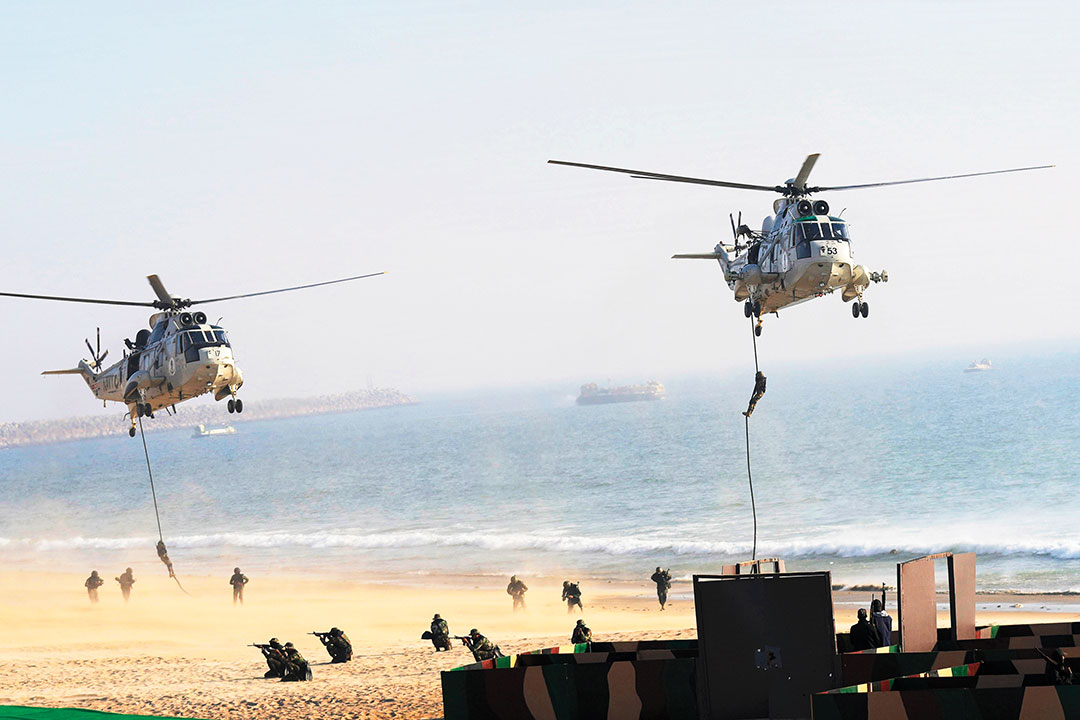
The past few decades have been marked by multiple wars and long military confrontations against terrorists. For example, Pakistani military forces conducted an extensive operation to eliminate terrorist safe havens within the country and improve the overall security of the region.
Known as Operation Zarb-e-Azb, the military carried out an operation against the Tehrik-e-Taliban Pakistan (TTP), al-Qaida and other terrorist groups in the North Waziristan region. Pakistani forces launched the operation in the North Waziristan Agency and the Federally Administered Tribal Areas near the Pakistan-Afghanistan border. Zarb-e-Azb was prompted by a deadly terrorist attack on Jinnah International Airport in Karachi. About 30,000 Pakistani Soldiers were engaged.
Zarb-e-Azb involved coordinated airstrikes, ground offensives and search operations. Pakistani intelligence agencies played a major role in identifying the targets and preventing insurgencies by the terrorist groups. In the airstrikes, the Pakistani Air Force targeted terrorist hideouts in Miranshah, capital of North Waziristan.
Following the strikes, a ground battle ensued between the Pakistani army and terrorist militants. In addition to the military offensives, search operations were conducted. This involved isolating target areas and capturing or eliminating insurgents and weapons in the area. Because the majority of fighting was done near the Pakistan-Afghanistan frontier, efforts were made to secure the border and prevent the movement of terrorists over the border. By 2015, 2,763 terrorists had been killed and 837 terrorist safe havens demolished.
The military operation in Shawal Valley marked the last phase of Operation Zarb-e-Azb. The operation has been regarded as a success in substantially reducing the terrorist networks within Pakistan. A large number of the TTP’s leadership was captured or killed. Although the operation is considered an effective example of military confrontation in combating terrorism, extremist activities persist in the region and countering them is a complex and ongoing matter.
Results
Over the years, governments have shifted their views on the use of military force in combating terrorism. In the latter half of the 20th century, military force was not seen as an entirely crucial part in fighting terrorists. In the U.S., more importance was given to legal approaches and police responses. However, the U.S. government gradually began militarizing its approach toward the end of the 20th century after the Iran hostage crisis. The 9/11 attacks in the U.S. brought the realization that there was a need for stronger counterterrorism measures.
The use of the military in hostage rescue missions and the fortification of embassies have been helpful in reducing the number of civilian deaths and blunting the effectiveness of terrorist attacks. However, a large military presence in the streets can increase fear and create distrust of a government’s counterterrorism operations.
Preemption, too, has been a controversial topic. Although preemptive military operations have led to the killing of a number of important terrorists, it is often hard to prove whether those operations prevented other deadly attacks.
Deterrence sends a clear message of a country’s military power and determination to terrorist groups. Various countries have used strong military responses to prevent future terrorist attacks on their territories. However, terrorist activities still continue in the long term despite such measures.
Military retaliation, when conducted with properly trained military units and effective planning, has destroyed important resources of terrorist groups and killed their members. Nevertheless, its effectiveness in the long term is still debated.
Killing of key figures in the hierarchies of terrorist organizations causes short-term internal power vacuums and contributes to decreasing the overall morale of terrorist groups. But assassinations can create a martyrdom effect and have sometimes encouraged more terrorist attacks.
Wars have demolished terrorist sanctuaries, disrupted sources of funding and have even nearly eradicated some terrorist groups. Despite the fact that complete elimination of terrorist activities has not been seen yet, wars have significantly decreased the operational capabilities of terrorist organizations.
The six ways of using military confrontation to combat terrorism have mostly borne results in the short term. However, in the long term, terrorist groups sometimes resume their violence. While there have been cases where instances of retaliation and full-scale wars have brought better results than expected, more research is needed on the specific conditions and context where wars against terrorism are more successful than others.
We also see that mere military confrontations — with a disorganized force, weak intelligence agencies and lack of community support — are not usually successful in eliminating terrorist groups.
Preventing terrorist organizations from continuing their activities requires community engagement to counter extremist ideologies that contribute to the formation of terrorist groups. Various countries have been using different strategies to damage terrorist organizations without causing physical destruction.
Among the strategies are employment of cybersecurity measures in our increasingly digital world and disruption of financial networks that support terrorism. Likewise, diplomatic efforts and international cooperation also play their part in countering global terrorism.
As we seek the best strategies to counter terrorism, we need a better understanding of the effectiveness of military confrontation and other counterterrorism measures before we move forward.
A version of this article was published by the Islamic Military Counter Terrorism Coalition.