
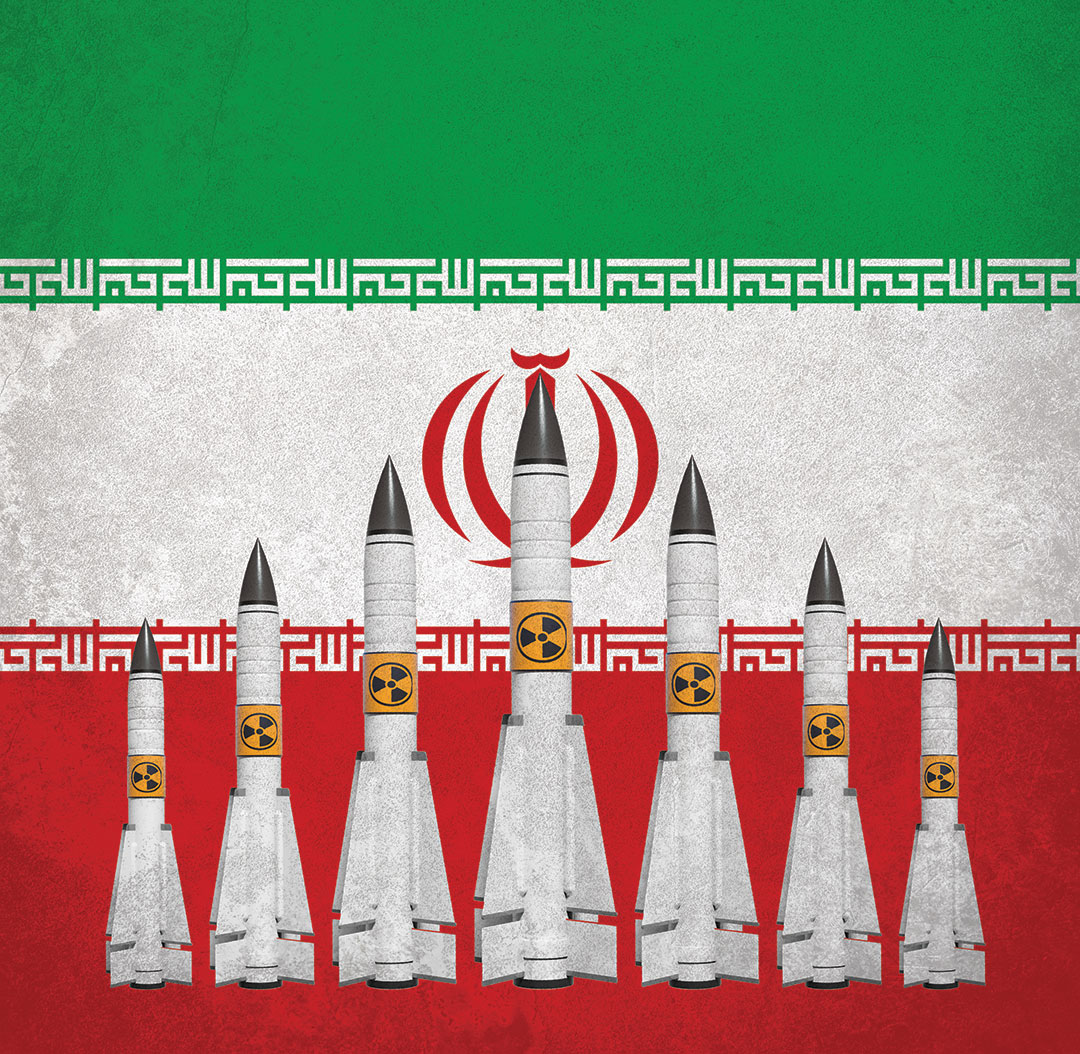
Many avoid asking what may be the most important question in the international debate over Iran’s nuclear program: If the Iranian regime possessed a nuclear weapon, would it hesitate to use it or hand it over to one of its proxy militias in the region?
This question is not hypothetical. It is necessary to evaluate the nature and behavior of this regime since 1979.
For 47 years, Iran has worked to export its schemes — built on revolution, violence, death and destruction through armed chaos — rather than seek stability or regional partnership.
Tehran has invested hundreds of billions of dollars in building a cross-border network of proxy militias, and supplied them with missiles, drones, training and money.
- In Lebanon, the state has struggled to disarm Hezbollah of its Iranian-supplied weapons.
- In Iraq, state sovereignty has been weakened under pressure from armed militias backed by Iran.
- In Syria, hundreds of thousands of people were killed as Iranian-backed militias turned the country into a regional battleground.
- In Yemen, Iran’s support for the Houthi uprising has led to a long war that has devastated the economy, plunged millions into a humanitarian crisis, and turned Houthi-occupied Yemen into a base for targeting international trade and maritime routes.
This record speaks not of political miscalculations or limited interventions. It is a fully integrated strategy built on a clear principle: the expansion of Iranian influence through militias and the chaos they create.
The nuclear threat is made even more dangerous
by the ideological dimension of the Iranian regime.
The regime’s official discourse is filled with slogans of death and hostility, and presents conflict as part of its political identity. Its strategic approach cannot be evaluated using traditional standards of nuclear deterrence, which assume that states, no matter how deep their disputes, ultimately seek to avoid destruction.
Instead, the Iranian regime has built its strategy around pursuing weapons of mass destruction through the development of a nuclear program, ballistic missile systems, drone capabilities and armed proxies operating beyond its borders.
This reality alone creates a dangerous strategic dilemma: If Iran possessed a nuclear weapon, would the regime use it? An equally serious question would be: Could this weapon, directly or indirectly, be transferred to one of its armed networks?
The history of the Iranian regime offers no reason to believe these possibilities are unlikely.
Over the years, Tehran has transferred missile technology, drones and advanced weapons to its affiliated terrorist militias. With every round of conflict in the region, these capabilities have spread further.
Imagine for a moment the Middle East under such a reality: The existence of a regime possessing a nuclear weapon and a network of cross-border militias engaged in open conflict in several states.
In such a scenario, a nuclear weapon would not remain a traditional deterrent. It could become a new element in Tehran’s wars — and in those of its proxies.
That is the real danger.
Today, the world faces not just a traditional nuclear proliferation issue but also the possibility that these weapons could spread to nonstate armed networks.
This possibility alone should inform how the international community deals with the Iranian regime.
The primary concern is no longer simply the existence of the nuclear program, enrichment levels or the number of centrifuges. Rather, the key issue is the nature of this regime that seeks to acquire nuclear weapons.
A regime that has spent decades building proxy militias and undermining state stability will not suddenly transform into a responsible power once it obtains a nuclear weapon.
On the contrary, possessing such a weapon may give it a greater sense of immunity and encourage it to expand its destabilizing activities in the region under the umbrella of nuclear deterrence.
If that were become reality, the Middle East would not be the only region at risk.