

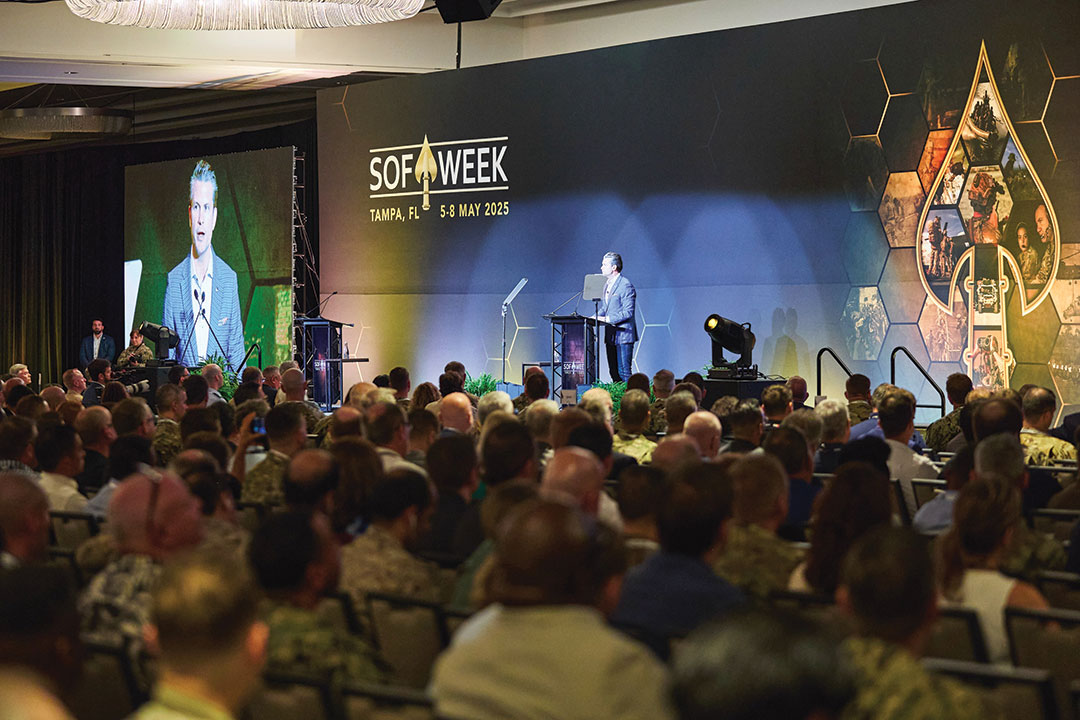
His Majesty King Abdullah II ibn Al Hussein of Jordan shared his insights with a gathering of leaders of special operations forces from more than 60 countries at Special Operations Forces Week in the United States in May 2025.
The annual convention, sponsored by the Global SOF Foundation and U.S. Special Operations Command, addresses tactical, strategic and technological developments in the field of advanced warfare. Attendance topped 20,000.
Amid the panel discussions, cutting-edge weaponry and seminars, thousands of visitors from around the world interacted with colleagues at the Tampa Convention Center in Florida. Their common goal was international security. In addition to the Jordanian contingent, officers from Bahrain, Iraq, Lebanon and Saudi Arabia added an even greater international representation to SOF Week.
In a ballroom holding an audience of 500, U.S. special forces and special forces senior leaders from dozens of countries listened to discussions about the future of their field.
Gen. Bryan Fenton, then-commander of U.S. Special Operations Command, described a volatile world in which asymmetrical, irregular and hybrid threats proliferate, causing political leaders to enlist his troops for crisis response, counterterrorism and deterrence. These efforts are “interwoven with Partners and Allies,” he said.
“We’re a scalpel … in a world that demands precision,” Gen. Fenton said.
In this new world of technological innovation, commanders need more than just “shooters,” presenters said. Modern forces also need computer experts, linguists, AI engineers and messaging specialists to combat contemporary threats.
Colby Jenkins, acting U.S. principal deputy assistant secretary of war for special operations and low-intensity conflict, concurred. He discussed the future of SOF in which kinetic operations and training no longer suffice.
Future special operations troops must conduct missions in harsh environments without secure supplies and communication, he said. They must be technically proficient across all domains: electronic, cyber and space. They must engage in influence operations in various media.
“The battlefield of tomorrow will be more complex, more contested and more ambiguous than anything we have faced before,” Jenkins said.
Few contemporary hot spots require large conventional forces, said Stu Bradin, president and CEO of Global SOF, which sponsored SOF Week for the third year in a row. So policymakers are looking to irregular warfare — exemplified by SOF — to confront threats.
“It is essential for special forces to form partnerships and build a solid network of professionals across the globe to defeat threats and overcome challenges,” Bradin said.
Entering the main exhibit hall of the convention center was like entering a huge mall, but instead of clothing and other consumer goods, the displays contained the latest weapons systems and technology used by military and security forces. Over 800 vendors displayed weapons and equipment from handguns to satellite tracking systems. Visitors wearing all kinds of military uniforms and patches circulated among the display booths assessing technology or a weapons system that fits the needs of their countries.
Among the attendees was a delegation from the Iraqi Counter-Terrorism Service (ICTS). Like others at SOF Week, they sought innovative technology to aid their mission of ridding Iraq of terrorism.
“Our priority is to be on top of advancing technologies for training and operations,” ICTS Commander Gen. Karim Al-Tamimi said. “SOF Week is very important to us as we meet our partners and counterparts from all over the world.”
The Bahraini Royal Guard Special Operation Forces were distinguishable by their berets and belts in a shade of bright green. The Bahraini colonel who led the delegation praised the opportunity to meet international colleagues and hear the latest news from their field.
“It is a great place to establish a network among professional special forces leaders around the world. I am sure one day we will need each other’s experience,” the colonel said.
He also highlighted the quality of the equipment on display.
“This place is like a candy store for special operatives, because of the abundance of weapons systems and technologies that elite forces wish to obtain.”
Lebanese Special Forces representatives were keen on making professional contacts with both military colleagues and defense industry representatives.
“The varieties of technologies and weapons are unimaginable. Additionally, we make new friends and build networks of professionals from across the world,” a Lebanese officer said. “I am very happy to listen to the senior leaders of U.S. special forces who share concerns and optimism about the Middle East that definitely match ours.”
Members of a large delegation from Saudi Arabia also enjoyed their time at SOF Week.
“Thanks to the organizers of the exhibition, as all the activities were fruitful, from the sporting activities of the special forces personnel every morning to the carefully selected seminars and lectures by senior commanders,” one officer said.
“We attended a lecture by Gen. Fenton, commander of U.S. Special Operations, as well as a lecture by Maj. Gen. Jeffers, commander, Special Operation Forces for U.S. Central Command, who gave their perspectives on security challenges facing the world.”
It was Maj. Gen. Jasper Jeffers who issued a cautionary note to the proceedings at SOF Week. He stressed that modern technology can be a double-edged sword. Much of it is relatively inexpensive and replicable, making it easy for adversaries to obtain.
“The tools, tactics and procedures we used to win the last 20 years aren’t going to work for the next 20 years,” Maj. Gen. Jeffers warned. “Therefore, the special operations must continue innovations and obtaining leading-edge technology to be ahead of the game.”