

 I would like to offer a perspective on the future of air warfare, which is rapidly approaching. Technological advancements have exponentially increased threats to manned aircraft. These threats range from ground-based air defense systems to fifth-generation fighters with long-range air-to-air missiles.
For pilots and operators who must manage these threats while also conducting missions professionally and effectively, their decision space is equally condensed. One way to mitigate the threats to manned aircraft and expand the decision space for pilots and operators is to supplement with unmanned systems where the risk is significant and the need for sensors and weapons in mass is present.
I will describe the benefits of unmanned aircraft, how U.S. Air Forces Central Command (AFCENT) is operationalizing advancements of unmanned technology, the limitations of unmanned systems, and how collaborative operations between manned and unmanned systems can multiply operational effectiveness.
Unmanned systems operations
Let us start with the rationale for joint manned and unmanned operations. For the air component to complete its mission and create effects in all domains, a degree of air superiority is necessary. Achieving air superiority is increasingly challenging because of the vast distances that need to be covered, stand-off weapons engagements, and threats at every altitude, not to mention electronic warfare and other nonkinetic effects aimed at degrading air superiority. Overcoming these challenges will require an integrated and networked cluster of air superiority capabilities.
Unmanned technology is not the entire solution but is a key enabler in this effort. Unmanned systems must conduct long-endurance missions spanning the vast distances required to fight in future wars. The ability to conduct long-endurance missions also provides more time for assets to identify targets and sense the operational environment within an enemy’s engagement zone.
Unmanned air assets will need to inform decision-makers or even make decisions, whether by human or artificial intelligence (AI), inside enemy airspace and with little to no communication with a commander in the rear headquarters. Unmanned systems, with automated and AI enhancements, will quickly process data to enable rapid decision-making. These systems must recognize friendly, neutral and hostile actors, and pass that information in near-real time for rapid prosecution.
The long-endurance and data processing benefits of unmanned systems are multiplied when employed using the principle of mass. The lower cost of unmanned systems, compared to that of advanced manned platforms, will allow industrial production at a scale and tempo necessary to meet the threat. The increased production capability allows us to develop a mesh network of systems, sending multiple unmanned systems equipped with varying sensors, to covering large areas and passing complementary data that increases situational awareness of the battlespace.
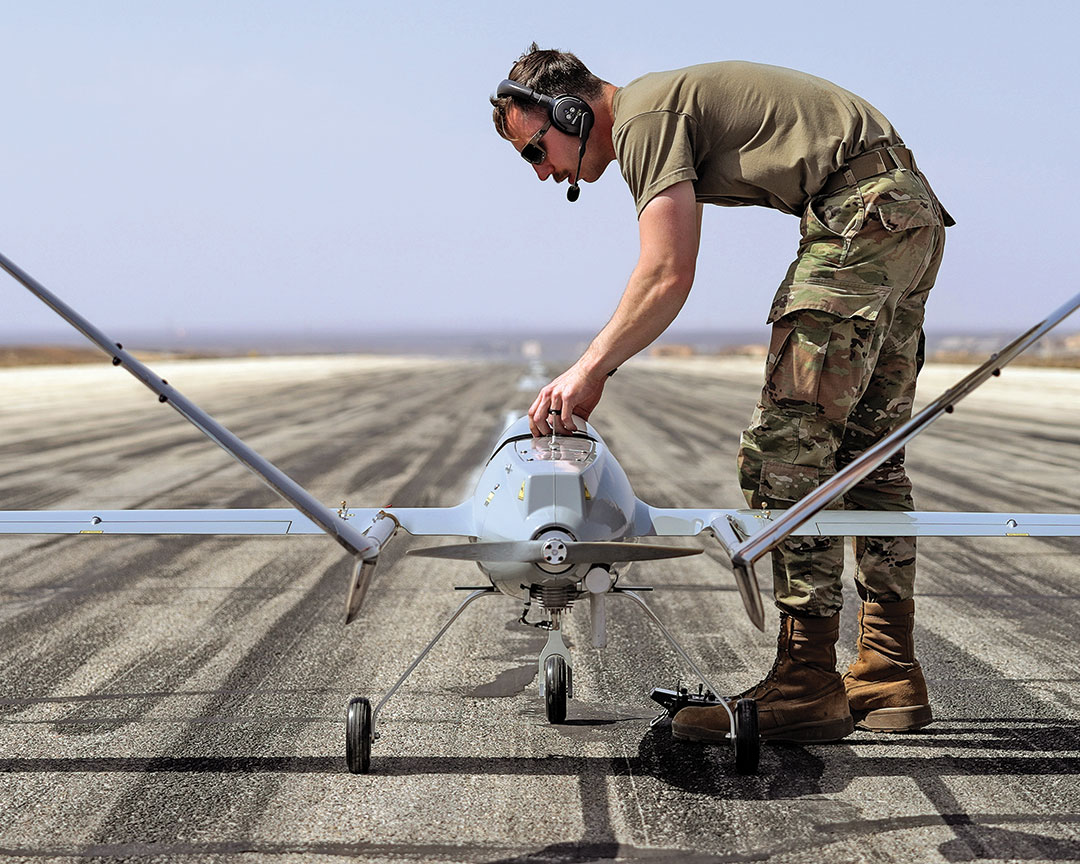
This concept of using unmanned platforms only works if they are affordable and can be manufactured rapidly. In an environment that demands rapid production, industry partners who “gold-plate” and up-price needed systems will not be competitive in the future procurement of unmanned assets.
A significant benefit of unmanned systems is that they have fewer life-support requirements than systems with a human in the cockpit. Instead of environmental control systems, the space can be dedicated to sensors and automated computing power to process information and make lower-level decisions in combat. Finally, unmanned systems provide the commander better options to find, fix, track, target, engage and assess targets while managing risk.
Unmanned systems’ limitations
Despite the benefits of unmanned systems, many issues can be solved only through human interaction. Unmanned systems are not a “one size fits all” to solve the air superiority dilemma. Rather, unmanned platforms are best used to bolster the operational effectiveness of manned systems. Unmanned systems and similar innovations must be tried, tested and proven with repeatable concepts of operation to make them effective in the expected operational environment.
In many areas, we will need humans in the loop to ensure decisions align with a commander’s intent.
The first area is target identification and evaluation. History has proven that, in the fog of war, identifying threats and targets from the air can be challenging. Unmanned systems can aid with threat and target detection, evaluation and identification with the ability to process a large amount of data from many sources, enabling rapid and confident detection of threats and targeting of an adversary. However, this is an area where any misidentification can lead to catastrophic results.
Automation and AI are not foolproof; they are subject to the limitations of data input, learned algorithms and computing capacity. For certain cases, humans are needed to validate decisions and tasks against known limitations. In general, the level and importance of validation is dependent on 1) the maturity of the automation and AI, 2) the complexity of the environment, and 3) the potential consequences of the decision. In combat, validation is highly desired based on the complexity of the environment, the fog of war, and consequences that are often life-or-death.
Even in noncombat scenarios, the principle applies. For example, if you flew into Doha, Qatar, on a commercial aircraft in poor weather that obscured visibility, you would probably be fine with the pilot using automation to land the aircraft. But would you feel the same if the pilot walked back and sat next to you in the cabin once the gear was down and the plane was making its approach?
So we need to think about how to build accountability into our unmanned technology. Commanders need to retain a degree of oversight of their forces, and that principle is even more imperative for unmanned platforms. If we are to rely on unmanned assets to supplement manned operations, we must ensure that a system is operating correctly and it’s aligned with the commander’s intent. The way unmanned systems come to a decision is just as important as the decision itself; they must be auditable and their calculations transparent. The data processing of unmanned systems should also be subject to monitoring to ensure that critical safety features have not been degraded.
Operationalizing innovation
Now that we have identified how unmanned systems can address many of the challenges we will face in future combat, we need to discuss putting these concepts and technologies into action. At AFCENT, we have a dedicated team charged with doing just that; operationalizing our innovation so we can quickly adapt to the ever-changing battlespace.
Task Force 99 (TF-99) is AFCENT’s innovative team that leverages commercial off-the-shelf digital and unmanned capabilities to create dilemmas for our adversaries and new opportunities for collaboration with our partners. The vision is a small, elite team with a broad range of specialties, with the potential to expand based on acquired capabilities and assigned missions. In more than two years of operations, TF-99 has already seen remarkable growth, expanding its geographic reach and increasing its capabilities.
TF-99 has three main lines of effort: increase air domain awareness, locate hard-to-detect targets, and impose costs and create dilemmas for our adversaries. These all contain elements of the unmanned systems concepts outlined to this point and use them for the innovative processes they are developing.
The first line of effort is to increase air domain awareness by building a resilient mesh network of low-cost sensors that provide constant information, operating as our eyes and ears at sea, on land and in the sky.
The second is to locate hard-to-detect mobile targets, which tend to complicate our old methods of targeting. The goal is to accelerate our targeting cycle to a speed faster than our enemy can manage, something on which we are already making tremendous progress by using AI.
Finally, the TF-99 team aims to impose costs and create dilemmas for adversaries. Our adversaries know our tactics, they understand our decision-making process and they read our doctrine. But by innovating with low-cost, fail-forward unmanned systems — able to operate semi-autonomously at speed and scale — we can rewrite the rules of engagement in our favor.
Multiplying the effect
Through examining the capabilities and limitations of unmanned systems, we believe the best use for this capability is for manned and unmanned assets to work together to meet military objectives. Conducting joint manned-unmanned operations will enhance the benefits that both platforms provide during conflict.
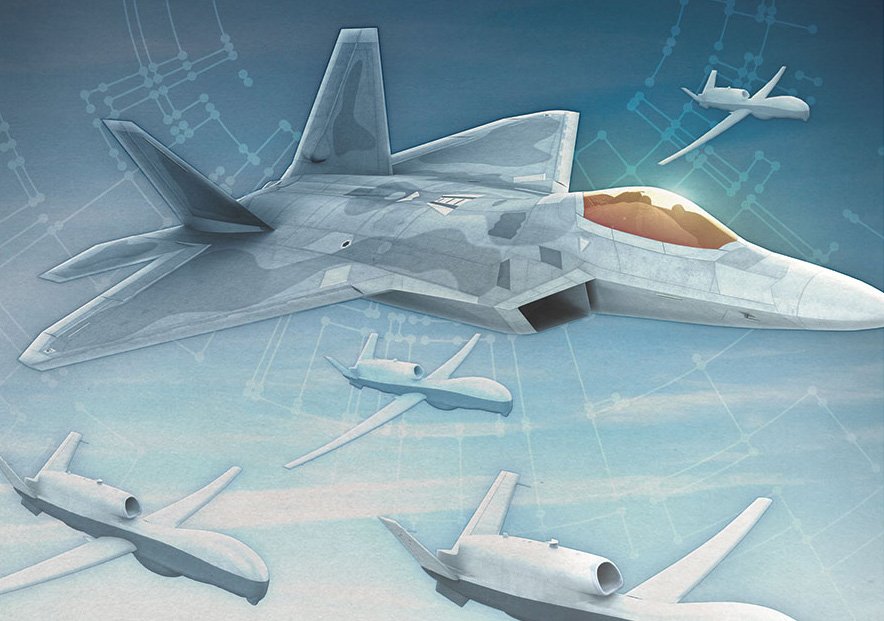
The concept of pairing manned and unmanned platforms is not new. For many years, we have incorporated unmanned systems, such as the MQ-1 Predator, used in operations since the 1990s, and MQ-9s. However, the next evolution of that concept is to use Collaborative Combat Aircraft (CCA) to perform a variety of missions to enable and enhance manned fighter capability. The CCA concept envisions manned fighter aircraft accompanied by one or multiple unmanned systems enabling the pilot to be more efficient and effective in combat.
CCA holds the promise of multiplying capacity or reintroducing the principle of mass into a continually shrinking fleet of fighter aircraft. We have touched on the concept of unmanned systems being able to employ as a “mesh network” of sensors, but with CCAs we are connecting that “mesh network” to a manned asset that maneuvers in the battlespace. Beyond sensors, CCAs have the potential to bring needed defensive jammers and countermeasures to increase survivability of both the CCA itself and manned aircraft. Finally, CCAs could be loaded with air-to-air or air-to-ground weapons to increase firepower.
A network of Collaborative Combat Aircraft could team with a single manned aircraft to provide capabilities and expand missions beyond a single manned fighter’s capability or capacity. A single fighter with a team of CCAs will theoretically be able to tailor these capabilities to make his operation the most effective, allowing him to prosecute threats, engage dynamic targets, strike deliberate targets and collect intelligence on future targets simultaneously.
To do all of this, the pilot in charge of operating such a network of CCAs will need help. To be effective, CCAs will require some autonomy — currently a limiting factor of CCA technology. While a realistic vision of CCAs right now would be two to three per manned fighter, this number could increase in the future as the technology matures.
As an analogy, the manned fighter would act as a lead musician playing an instrument in a musical trio, and as CCA technology matures, the manned fighter would eventually become the conductor of a large orchestra, directing with a baton but not actually playing an instrument himself.
Conclusion
We have seen remarkable advancements in unmanned systems technology, which has the ability to enhance the effects of manned assets. However, new threats emerge every day and we must adapt and change tactics, techniques and procedures to outpace them.
AFCENT is striving to do this through Task Force 99, which is paving the way for innovative collaboration between manned and unmanned systems. We realize that unmanned systems do not provide an overarching solution for all air domain challenges. But synchronizing operations between manned and unmanned systems multiplies the effect of airpower and gets us closer to achieving the goal of air superiority.
- Unmanned systems allow for increased flexibility and endurance at lower cost.
- Task Force 99 is paving the way for innovative collaboration between manned and unmanned systems.
- Unmanned systems do not provide a singular solution for all air domain challenges.
- Synchronizing operations between manned and unmanned systems multiplies the effect of airpower.