

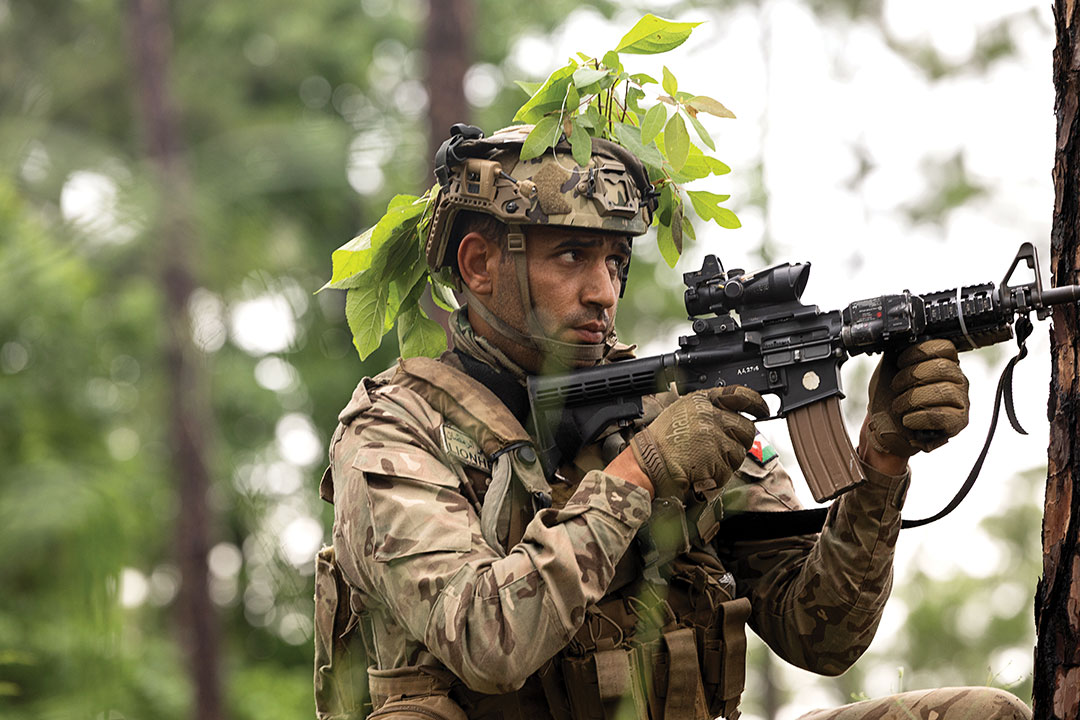
In a bustle of machine-gun fire, helicopter assaults and armored attacks, a company from the Jordan Armed Forces (JAF) Quick Reaction Force trained for the first time at one of the premier military training sites in the United States.
The Jordanian troops completed their demanding combat training rotation in June 2025 at the Joint Readiness Training Center (JRTC) at Fort Polk, Louisiana. It was the culmination of nearly a year of preparation for troops hand-selected from among the three battalions of the Jordanian Quick Reaction Force.
Although U.S. Army troops regularly participate in Jordanian-hosted exercises such as Eager Lion, this was the first time a Jordan Armed Forces company-sized unit trained at a U.S. combat training center.
The training demonstrated the strength of the U.S. and JAF partnership, as well as the interoperability between U.S. and Jordanian forces as they conducted offensive and defensive maneuvers in a natural setting.
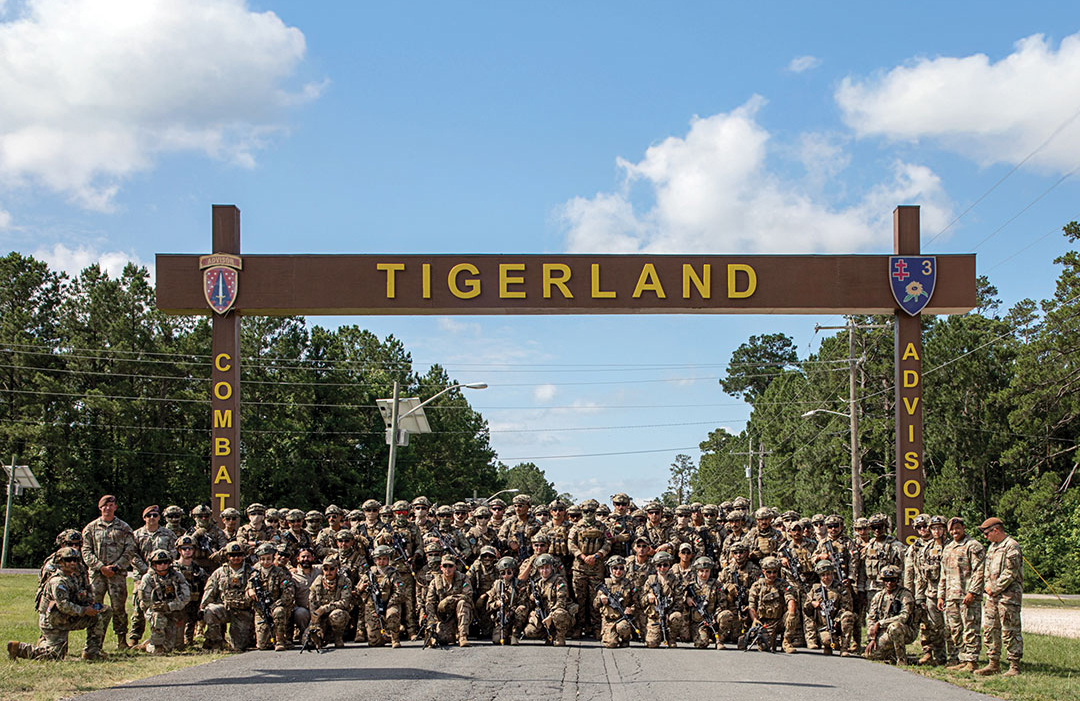
JRTC is one of the U.S. Army’s three premier combat training centers. Its mission is to improve military readiness through intensely realistic joint and combined arms training. Jordanian troops engaged in simulated combat operations against an opposing force consisting of skilled U.S. troops portraying the enemy.
In the case of the June 2025 maneuvers, the U.S. Army 34th Infantry Division, mainly Soldiers from the Minnesota and Iowa Army National Guards, filled the ranks of the opposing combat team.
The terrain at Fort Polk JRTC provides a challenge for participating training forces. It’s hot, humid and heavily forested, limiting communication and visibility among combat units. Water obstacles, including swamps inhabited by snakes and alligators, raise the intensity further.
The Jordanian troops vowed to share the training acquired in the U.S. with members of their units back home, said Capt. Sharaf Alshawabkeh, the Jordanian company commander in Louisiana.
“Just being here we’ve learned so many different things on the military side,” Capt. Alshawabkeh said.
Before Jordanian troops engaged in combat scenarios, they trained for months with counterparts with the U.S. Army’s 3rd Security Forces Assistance Brigade (SFAB). The SFAB has trained with forces from Jordan, Saudi Arabia and the United Arab Emirates.
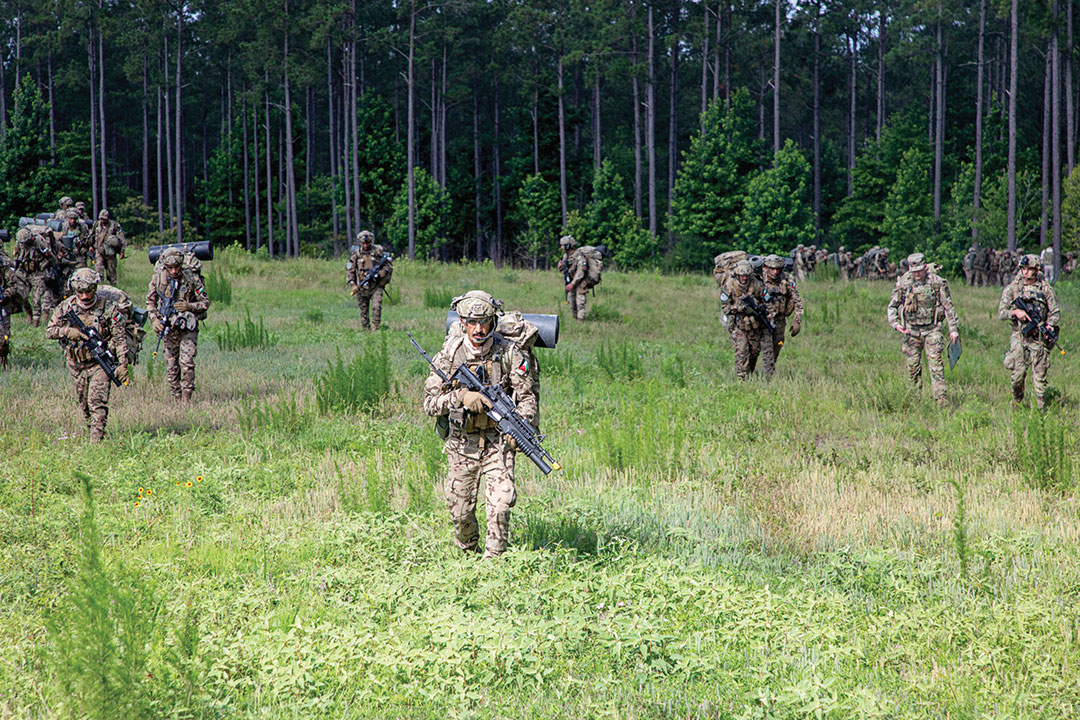
“It was fantastic seeing these Soldiers come out and utilize the training,” said U.S. Army Staff Sgt. Raul Lopez. “After nine months of working closely with them — training, building the partnership and strengthening their skills — it was gratifying to see them apply that training during the live-fire exercise.”
The Jordan Armed Forces has been a source of stability in the Middle East, and U.S. Central Command (USCENTCOM), its partner in many training events, was eager to invite elite Jordanian Soldiers for more rigorous combat drills in the U.S.
“This effort aimed to strengthen the partnership between the JAF, U.S. Army and USCENTCOM, while also demonstrating the combined lethality and operational capability of both militaries,” said Col. Charles Canon, head of security cooperation for U.S. Army Central Command.
During a visit with participating forces at Fort Polk, Lt. Gen. Patrick Frank, commanding general of U.S. Army Central Command, spoke highly of the exercise, underscoring the strength of the partnership between the JAF and the U.S.
“Just a few months ago, this was merely a vision,” Lt. Gen. Frank said. “Now we stand together at JRTC, ready to train, fight and demonstrate the combined lethality of our forces.”
In 2023, a United Arab Emirates company also completed live-fire combat training at the JRTC, and U.S. commanders hope to widen such cooperation with other military partners.