

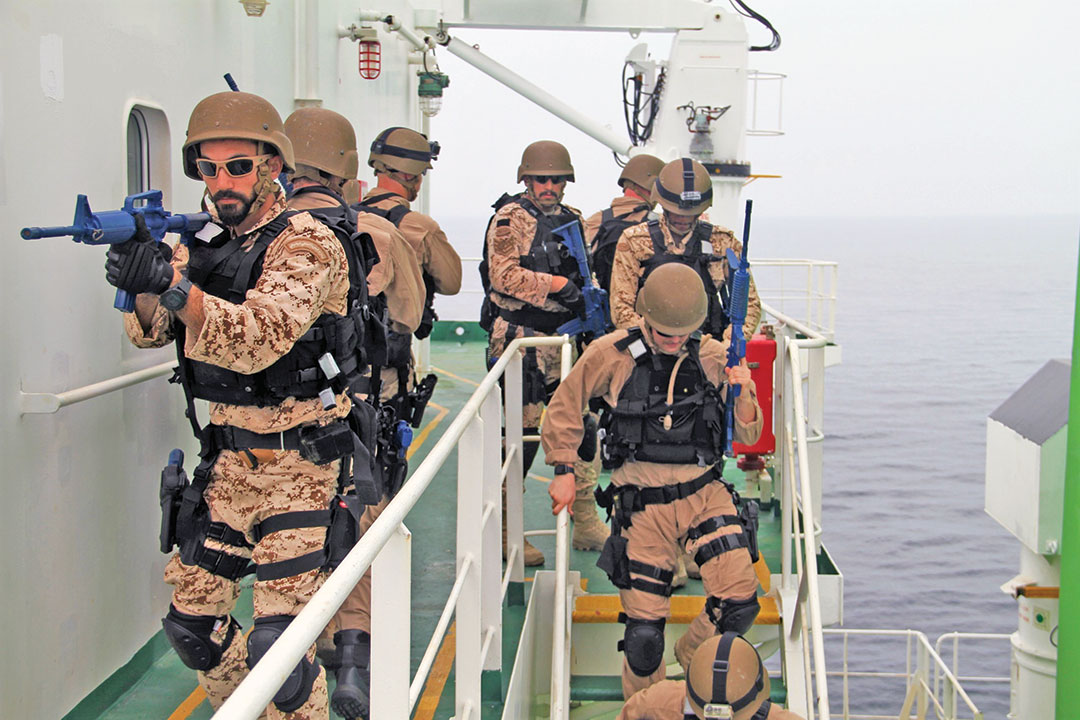
As the region experienced intense aerial assaults in late February 2026, the response of the Bahrain Defence Force (BDF) was exemplary.
It intercepted and destroyed numerous hostile targets — including ballistic missiles, cruise missiles, and unmanned aerial vehicles (UAVs) — achieving an interception rate exceeding 96 percent, according to field estimates announced during the crisis.
Bahrain’s success was not solely the result of technological superiority in air defense systems. Rather, it reflected the effectiveness of a broader national security model that integrates military deterrence, internal security coordination and societal resilience.
Bahrain calls this integrated framework the Security Sword Theory.
Defining the theory
The Security Sword Theory describes a comprehensive national defense doctrine in which military power, institutional coordination, and societal cohesion function as a unified strategic system capable of confronting complex modern threats.
Unlike traditional security doctrines that emphasize battlefield capability alone, Security Sword recognizes that contemporary conflict operates simultaneously across military, institutional, and psychological domains.

The doctrine conceptualizes national defense as a sword composed of two essential elements:
The Blade: Military deterrence and technological ability to intercept and neutralize external threats.
The Guard: Internal security coordination and societal cohesion that preserve national stability during crises.
When these two elements operate together, the state is capable not only of defending its territory but also of maintaining internal resilience against psychological and informational warfare.
Iran’s attack
In the early hours of February 28, 2026, Iran launched a large-scale aerial assault against the Kingdom of Bahrain as part of a broader regional escalation targeting several Arabian Gulf states.
The attack involved multiple strike platforms, including surface-to-surface ballistic missiles, particularly Shahab and Qader variants; air- and sea-launched cruise missiles; and swarms of kamikaze UAVs such as Shahed-131 and Shahed-136.
Targets appeared to be strategic infrastructure such as power facilities, military installations, residential areas and Bahrain International Airport.
Despite the scale and complexity of the assault, Bahrain’s military establishment demonstrated a high level of preparedness. The BDF employed a multi-layered air defense architecture capable of intercepting threats across multiple altitudes and ranges.
Official statements from the General Command confirmed that all defensive systems remained at maximum operational readiness throughout the crisis.
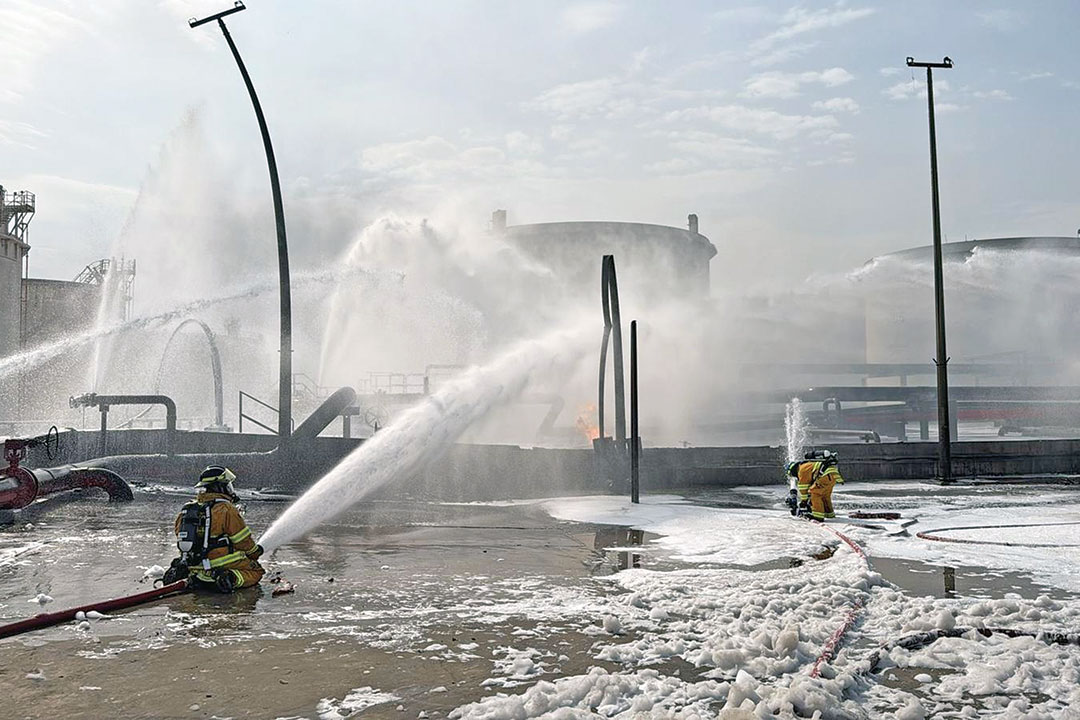
Integrated Security Triangle
A key operational element of the Security Sword Theory is institutional coordination between national security agencies.
Bahrain’s response demonstrated the effectiveness of what can be described as a security triangle composed of three core institutions:
- Bahrain Defence Force: responsible for external defense and air defense operations
- Ministry of Interior: responsible for civil protection and domestic security
- Bahrain National Guard: responsible for protecting strategic national infrastructure
This integrated coordination enabled the state to simultaneously defend its airspace, protect civilians and secure vital infrastructure.
The Ministry of Interior activated emergency civil protection measures, secured affected districts such as Juffair, and ensured the safety of residents through crisis management procedures.
Other government institutions adopted precautionary measures as well. Remote work and distance learning policies were implemented to reduce civilian exposure, while the Ministry of Foreign Affairs advised Bahraini citizens in Iran to depart ahead of the escalation.
Psychological warfare and information operations
Modern warfare increasingly combines kinetic attacks with psychological and informational operations designed to destabilize targeted societies.
Missile strikes and drone attacks are often accompanied by disinformation campaigns intended to amplify fear, undermine trust in institutions and create the perception of state vulnerability.
Adversaries frequently employ several psychological tactics:
- Fear amplification through exaggerated reports of destruction or casualties
- Institutional delegitimization by portraying government institutions as incapable of protecting citizens
- Narrative inversion, framing aggressors as victims and victims as aggressors
- Information saturation, flooding digital platforms with manipulated imagery and unverified reports
The strategic objective of these operations is not necessarily physical destruction, but psychological disruption within the targeted society.
Societal cohesion as strategic defense
The Bahraini experience demonstrates that societal cohesion can function as a critical defensive layer against psychological warfare. Three factors proved decisive in maintaining societal stability during the crisis.
Institutional Credibility: Timely communication from the Bahrain Defence Force and the Ministry of Interior helped prevent the spread of rumor and misinformation. Transparent updates strengthened public confidence in the state’s ability to manage the crisis.
Public Awareness: Public awareness regarding the risks of misinformation reduced the effectiveness of hostile information campaigns. Citizens relied on official communication channels rather than unverified social media reports.
National Unity: Rather than producing social fragmentation, the attacks reinforced national solidarity. The population demonstrated resilience and discipline during the crisis, strengthening the stability of the home front.
This phenomenon illustrates a key principle of psychological warfare: When national cohesion remains strong, adversarial information operations often fail to achieve their intended effects.
The human dimension
Beyond technological capability, the Bahrain Defence Force demonstrated exceptional professionalism and vigilance.
Air defense personnel maintained continuous operational readiness during several days of sustained defensive activity. Their performance illustrates a fundamental principle of military strategy: advanced technology is only effective when supported by disciplined and highly trained personnel.
In this sense, the defenders of Bahrain represented more than a military force. They embodied the vigilance and determination necessary to protect the nation during crises.
Strategic Lessons
The response to the recent attacks in Bahrain reinforces several key lessons for modern national defense doctrine:
- Technology alone cannot guarantee security.
- Military systems must operate within an integrated national framework.
- Institutional coordination multiplies defensive effectiveness.
- When defense forces, internal security institutions and civilian authorities act together, national resilience increases significantly.
- Societal cohesion is a strategic asset.
- Modern conflicts often target psychological stability as much as physical infrastructure.
Conclusion
The defensive success achieved by the Kingdom of Bahrain during the February 2026 crisis was not accidental. It reflects the culmination of a long-term strategic vision focused on building a modern military force supported by strong institutions and a cohesive society.
The Security Sword Theory provides a conceptual framework for understanding how states can defend themselves against complex aerial and hybrid threats. In this model, national defense is forged not only through military capability but also through institutional coordination and societal resilience.
The sword of national defense is therefore composed of two inseparable elements: a sharp military blade capable of deterring aggression and a resilient societal guard that protects the stability of the nation itself.