

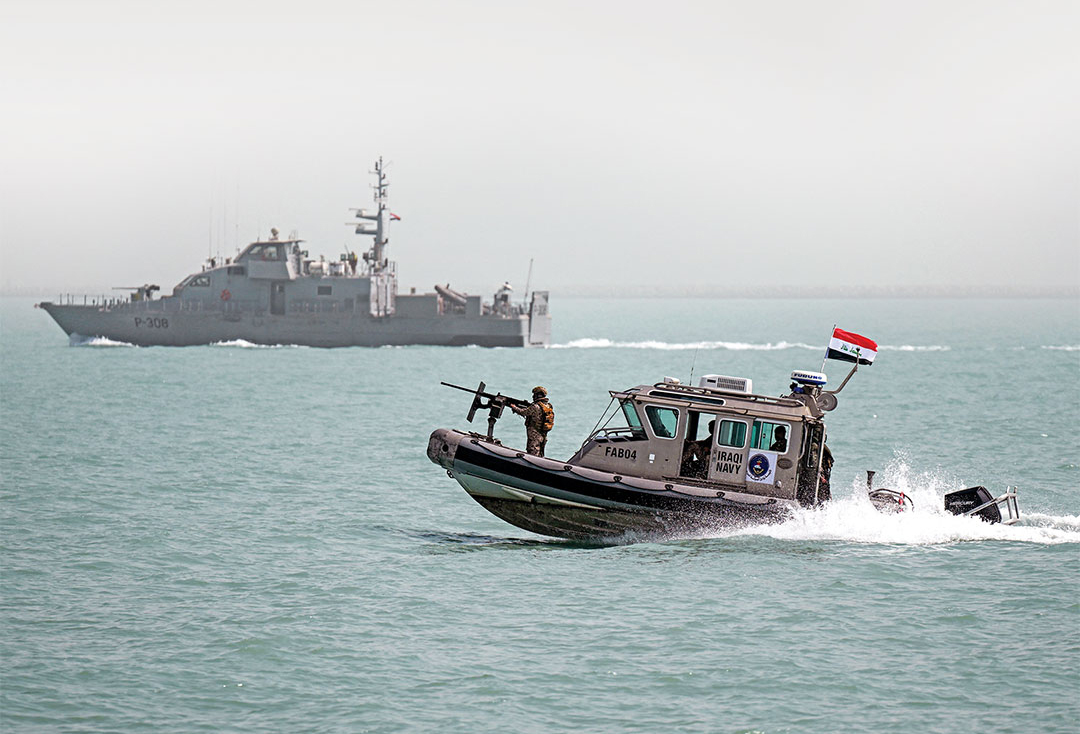
Since 2024, Vice Adm. Mazin Abdulwahid Alameri has commanded the Iraqi Navy, which has grown in importance as the defender of Iraqi ports vital for the country’s economic security.
It consists of patrol boats that protect the waters near the deepwater port of Um Qasr on Iraq’s narrow southern coastline. It’s also the main defender of the country’s territorial waters and maintains Iraq’s interests and sovereignty in adjacent waters and economic zones.
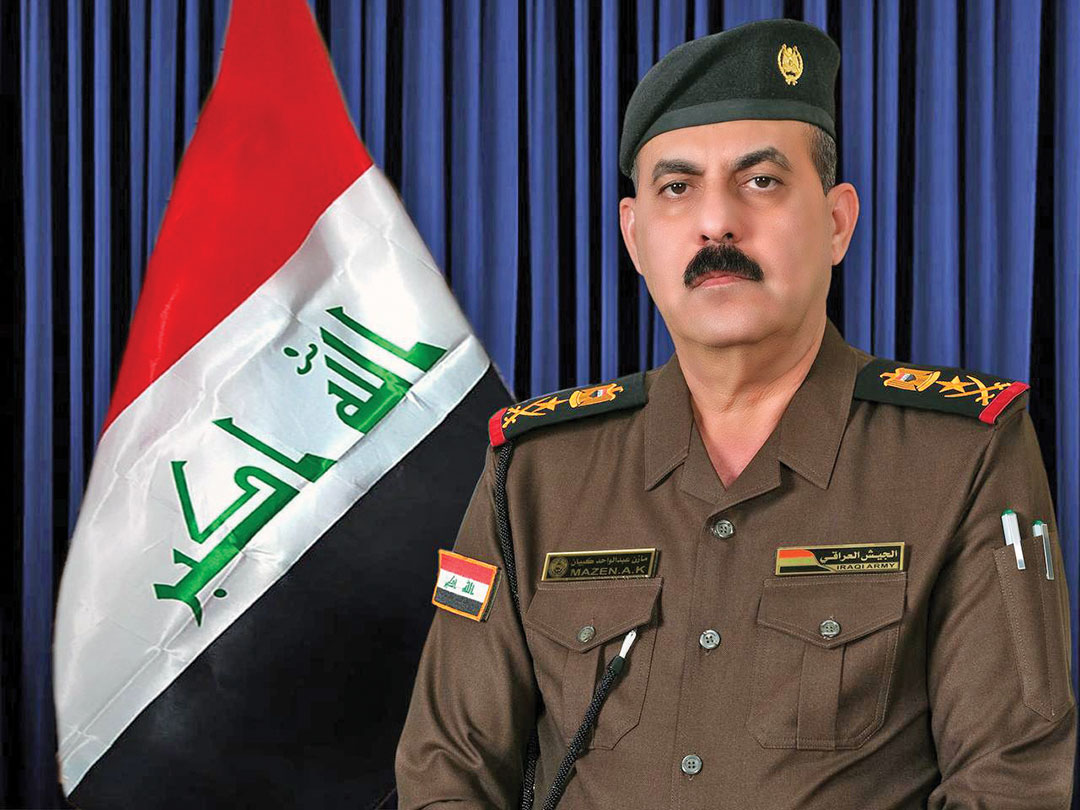 “The Navy protects Iraq’s commercial and oil ports, thereby securing the country’s main economic artery. This is why the Iraqi Navy is so important and plays such a vital role in maintaining the country’s stability and economy,” Vice Adm. Mazin said. “It also secures Iraq’s territorial waters and combats smuggling across these waters.”
The vice admiral aims to establish a cohesive naval fleet sufficiently large and well-equipped to impose complete control and prevent all breaches within its area of responsibility. That is more important than ever with the expansion of maritime facilities such as the opening of the large port of Al-Faw.
A critical part of his program is maintaining trusted partnerships with friends and allies equally committed to the security of the northern Arabian Gulf.
“The Arabian Gulf region is a shared economic zone with overlapping borders and multiple interests. Joint and continuous coordination through these partnerships is a vital factor in maintaining security in this region, where interests are shared and influential at the regional and global levels, given the region’s importance and influence on the global economy,” he said.
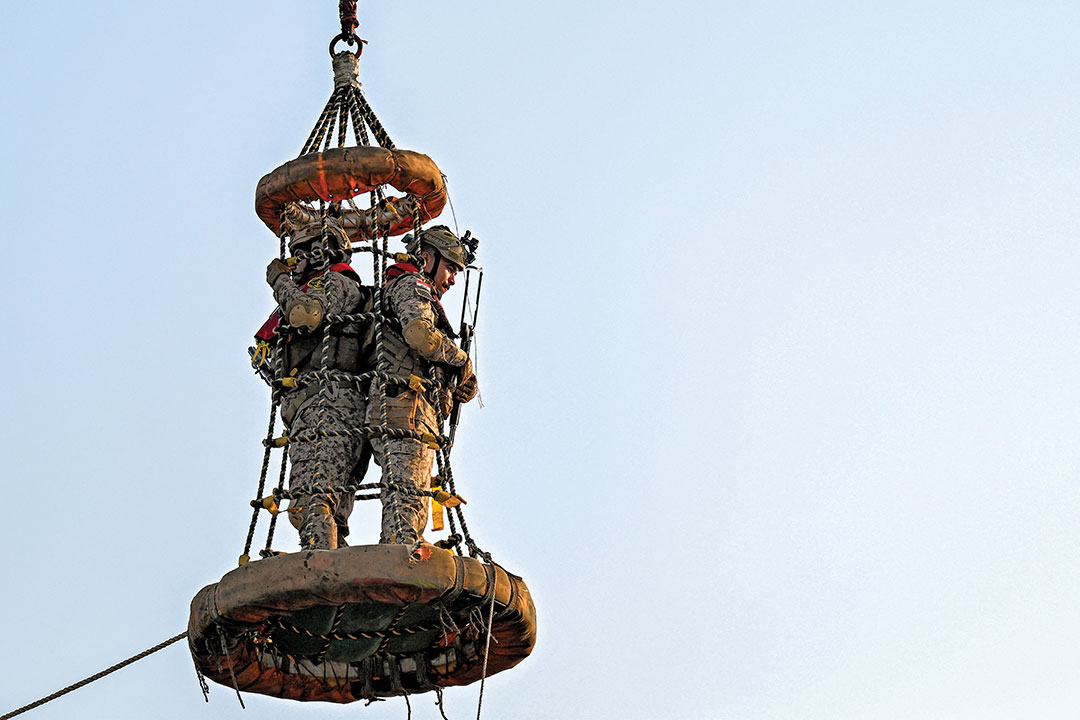
The vice admiral vouches for training and exercises to broaden the experiences of Sailors and send a strong message to would-be adversaries that Iraq can protect its coast. Internally, the Navy trains with counterparts in the Iraqi Air Force and Counter-Terrorism Service, both of which bring unique skills to augment the Navy’s.
“These Iraqi exercises train forces in amphibious operations, special operations, liberation of islands
and territories, and rescue and recovery missions,”
Vice Adm. Mazin said.
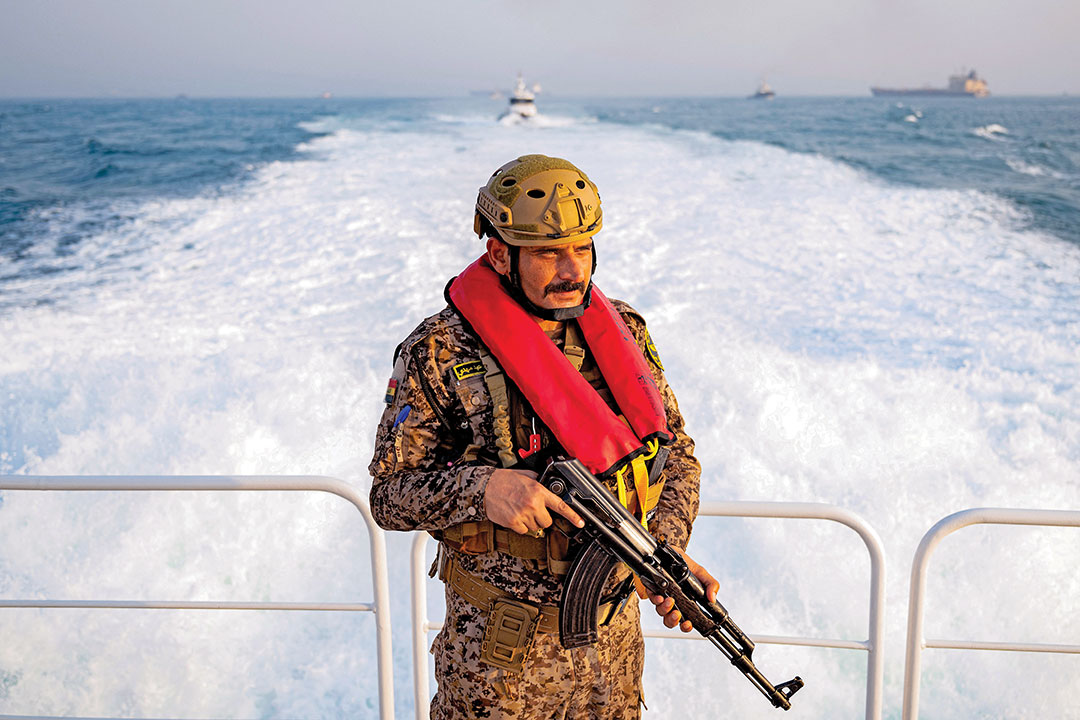
The Iraqi Navy also participates in regional exercises with Arabian Gulf states, as well as joint exercises conducted under the command and supervision of the United States 5th Fleet in Bahrain. These exercises emphasize skills such as visit, board, search and seizure; mine clearance; securing vital infrastructure; and naval gunnery.
“They play a major role in developing the capabilities of Iraqi crews,” the vice admiral added. “They increase their expertise and knowledge and develop their abilities and efficiency in performing tasks and duties.”
Military deterrence is one way to avoid armed conflict in a tense region facing multiple challenges. So is choosing leaders with experience and wisdom to negotiate the region’s conflicts.
“A successful leader must show wisdom in decision-making, must not rush into things, and not overreact to conflicts and bow to pressure,” he said. “He must also be quick-witted and able to improvise in moments and situations that require fast, accurate decisions. It’s also important for leaders to maintain balanced relationships with all parties and be able to reconcile viewpoints through tact and good management.”
Vice Adm. Mazin scaled the ranks of the Iraqi Navy during his military career with a focus on molding men to be a more effective fighting force. In addition to serving in the Iraqi Naval Inspectorate, which ensures the fleet can perform its maritime security duties, he spent much of his career in charge of the Arabian Gulf Academy for Naval Studies. The academy, on the Shatt al-Arab near Basrah, offers degrees in nautical science to officers destined for the Navy or the merchant marine.
“I wanted to serve my country and earn the honor of serving the flag through the military and to defend Iraq’s sovereignty and interests,” Vice Adm. Mazin said. “This is one of the noblest duties entrusted to a person.”
The vice admiral prides himself on being a student of history and takes inspiration from legendary military leaders like Khalid ibn al-Walid. The early Arab commander was famous for defeating Byzantine troops at the Battle of Yarmouk in the seventh century, the first major victory by Muslim armies outside the Arabian Peninsula.
“The battle lasted six days, and on the sixth day, Khalid changed his strategy from defense to offense. With his extraordinary genius, he managed to launch a risky attack on the Romans and used a military tactic that was unique at the time, which was to make proper use of the capabilities of a fast-moving cavalry brigade to turn imminent defeat into a resounding victory,” Vice Adm. Mazin said.
The vice admiral’s command philosophy focuses on instilling loyalty, pride and competence in his men. In an echo of his days in the naval academy, he monitors the development of his personnel, identifies their needs and seeks solutions to problems that may hinder their performance.
“I believe in a commitment to military discipline, learning, and working to develop academic and physical abilities so that they can keep up with technological developments in the world’s advanced navies,” he said.