
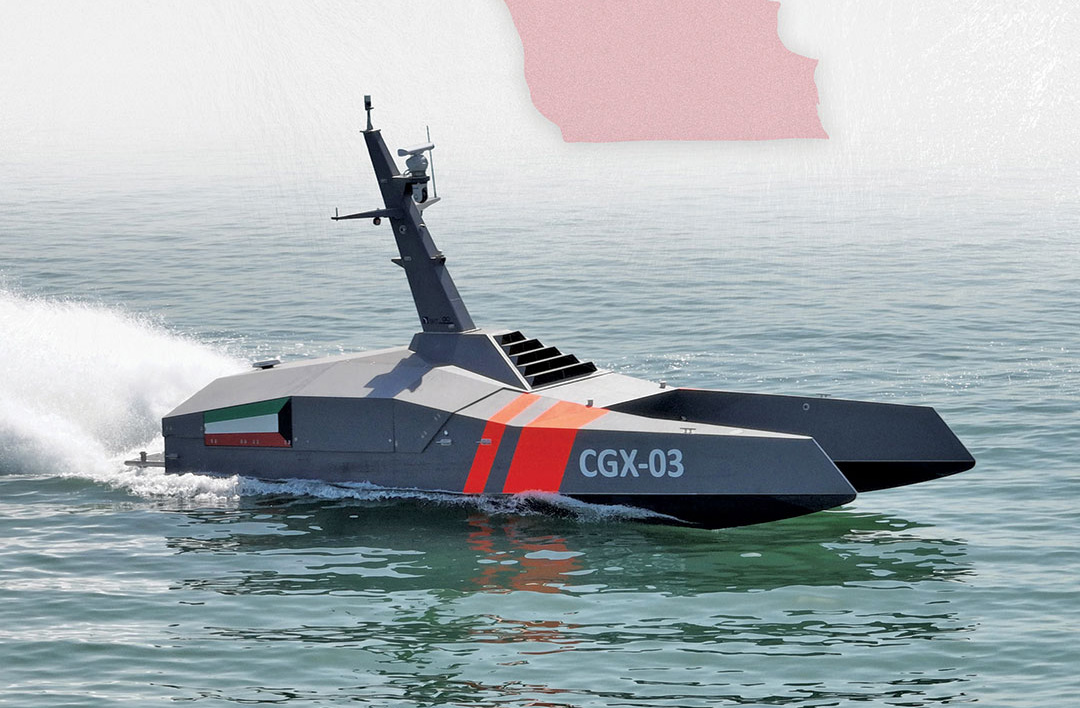
Kuwait’s First Deputy Prime Minister and Interior Minister Sheikh Fahad Al-Yousuf Al-Sabah has inaugurated a fleet of unmanned surface vessels (USV) to boost the country’s defensive capabilities.
The addition of the USVs in June 2025 was a major step toward bolstering Kuwait’s maritime security through the use of the newest technology, the minister said in a statement. The move also reinforces the Kuwait Coast Guard’s focus on innovative solutions to protect territorial waters, preserving national security and stability, he said.
The inauguration ceremony was attended by Maj. Gen. Ali Mesfer Al-Adwani, acting undersecretary of the Ministry of Interior, and Maj. Gen. Mujbil Fahd bin Shawq, assistant undersecretary for the Border Security Sector, as part of a comprehensive plan implemented by the Coast Guard.
Commodore Sheikh Mubarak Ali Al-Sabah, director-general of the Coast Guard, provided a detailed briefing on the advanced operational capabilities of the USVs, saying they can function autonomously for days without direct human intervention. This new class of USVs is double-hulled and 14 meters long.

Their primary missions include surveillance, continuous monitoring, interception of suspicious maritime targets, support for search and rescue operations, monitoring environmental pollution, protecting natural resources, and overall maritime security enforcement within Kuwait’s territorial waters.
Sheikh Fahad also inspected the advanced maritime monitoring system the country is installing. This system covers all of Kuwait’s maritime domain and integrates coastal radars, sensors, high-resolution cameras, and unmanned surface vessels under a unified command and control system powered by artificial intelligence.
Sheikh Fahad toured the maritime operations center as well as the control center that operates the USVs, reviewing their operational mechanisms, monitoring systems, and the electronic network linking the maritime units with command centers.
Unmanned maritime drones, including aerial varieties that operate overhead and submersible types that operate underwater, have helped navies and coast guards extend surveillance beyond the range of manned vessels. U.S. Navy Central Command has launched thousands of such unmanned vessels and vehicles to increase security in the region.
These unmanned vessels are deployed in places such as the Arabian Gulf and the Red Sea to detect terrorists, smugglers and other criminals. Navies have also integrated them into their training regimens at events such as the annual International Maritime Exercise in Bahrain and Jordan.